SOEPnewsletter November 2026
Dear SOEP Community,
In this issue of the SOEPnewsletter, you will find information on new data releases in Data Service, including the SOEP-Core data 1984–2025 (v42), as well as reports on current projects and events in News and Events. We also introduce our new “Social Cohesion” project and provide updates on further SOEP activities. As always, we present a selection of interesting new publications based on SOEP data in People & Papers and share the latest news from the SOEP community in SOEP Staff News and Community News.
We hope you enjoy reading!
Best regards,
Your SOEP Knowledge Transfer Team
Data Service keyboard_arrow_up
SOEP-Core Data 1984–2025 (v42) now available
SOEP-LEE2-Compare Data 2022–2024 (v2024) now available

Linking data: New Leibniz infrastructure strengthens interdisciplinary research
The new “Geolinking Service SoRa” will make it easier to link survey data with geospatial data in the future. Jointly developed by IÖR, GESIS, and SOEP at DIW Berlin, the new research data infrastructure strengthens interdisciplinary research on social and spatial developments.
News and Events keyboard_arrow_up
News
SOEP Policy on the Use of AI and Large Language Models (LLMs)
We would like to point out that the use of SOEP data in AI applications or for training AI models is not permitted under our new SOEP Policy on the Use of AI and Large Language Models (LLMs). We reserve the right to take legal action in the event of violations. Thank you for your understanding.
New Project: Social Cohesion
Since 2020, the federal-state program “Social Cohesion” has supported disadvantaged urban neighborhoods and local communities. It continues the previous “Socially Integrative City” program. However, there has so far been little robust evidence of whether and how this funding changes the lives of people in these areas.
This is where our new project comes in: funded by the Federal Institute for Research on Building, Urban Affairs and Spatial Development, SOEP is collecting an additional sample in funded areas and in comparable non-funded (but otherwise similar) areas. Households will be surveyed in 2026 and 2027 and are expected to continue participating in the SOEP core study from 2028 onwards.
This will create a unique database that allows the effects of funding to be measured simultaneously across many areas of life: income and employment, housing and housing costs, health and life satisfaction, social participation, trust, and political attitudes.
The data will be made available to the scientific community through the SOEP Research Data Center (FDZ SOEP) as part of the upcoming data release v43.
Highlights from recent Events
SOEP at Conference Honoring Shlomo Yitzhaki
On November 2 and 3, Carsten Schröder and Lotte Maaßen represented SOEP online at a conference in Jerusalem honoring economist Shlomo Yitzhaki, who passed away in 2023. They presented their paper “Inheritances and the Structure of the Wealth Distribution in Germany.” Schröder also paid tribute to his long-standing scientific collaboration with Yitzhaki, with whom he co-authored numerous publications.
ÖAW-STAT Lecture: Sabine Zinn on the Value of Longitudinal Studies
At the 11th ÖAW-STAT Lecture in Vienna on October 21, SOEP Director Sabine Zinn spoke about the importance of longitudinal data for research and policymaking. Using SOEP as an example, she demonstrated how long-term studies make the causes and consequences of social change visible, thereby supporting evidence-based political decision-making.
MORE INFORMATION (only in German)
Successful SUARE-II Workshop in October
On October 8 and 9, the team of the research project “Longitudinal Study on Refugees from Ukraine in Germany (SUARE)” met at DIW Berlin to launch the second project phase. A key focus will be the long-term consequences of family changes resulting from displacement, particularly for the development of children and adolescents.
Project Team at the SUARE I/II Kick-Off Meeting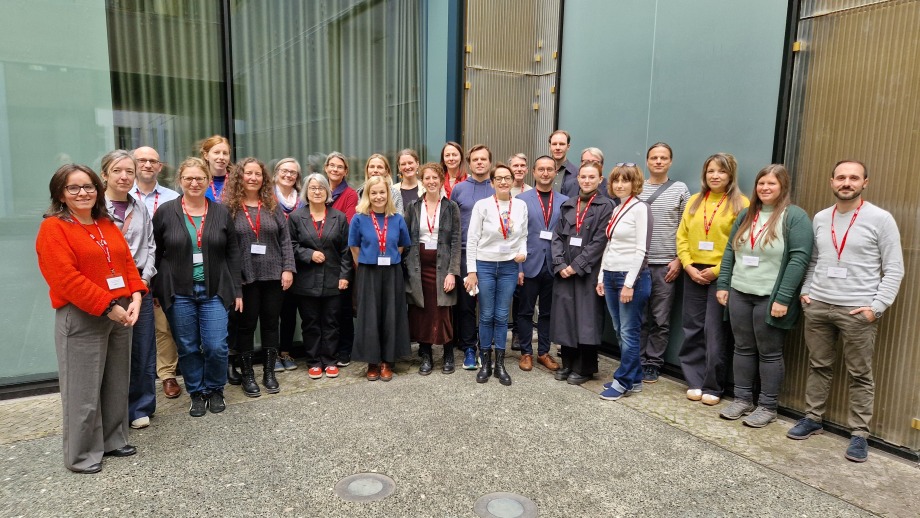
© DIW Berlin
SOEPcampus@DIW Berlin: Two Days of Intensive Exchange on SOEP Data
On 6 and 7 October, SOEP welcomed 30 participants from Germany and abroad to the annual in-person SOEPcampus workshop at DIW Berlin.
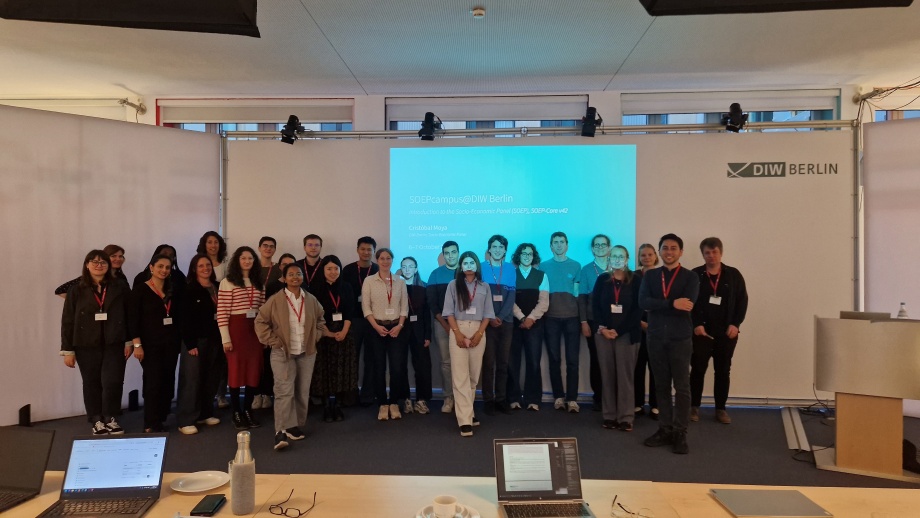
SOEPcampus@DIW Berlin, workshop from October 6-7, 2026
© DIW Berlin
SOEP-RegioHub: Two Days of Research and Exchange
At the Annual Research Retreat 2026 of the Leibniz ScienceCampus SOEP-RegioHub, principal investigators and doctoral researchers met on October 6 and 7 at Bielefeld University. The program included presentations, discussions of ongoing research, and networking within the research network. Junior Professor Marcus Biermann delivered the keynote address.
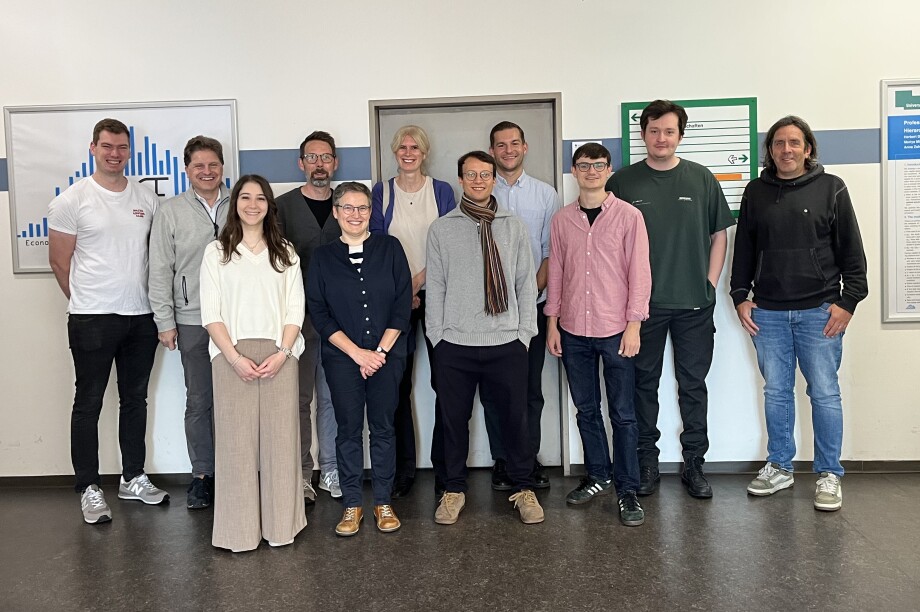
Annual Research Retreat 2026 of the Leibniz ScienceCampus SOEP-RegioHub
© University of Bielefeld
People and Papers keyboard_arrow_up
SOEP expert interviewed about East-West differences
Markus M. Grabka was interviewed by several media outlets, including RedaktionsNetzwerk Deutschland (rnd.de) (accessible to subscribers) and web.de, as an expert on the continuing differences between East and West Germany. In the interviews, he discussed findings on wealth inequality, regional development, and social mobility based on current SOEP data.
SOEP in the Media
No evidence of increased sick leave around public holiday bridges
There is no robust evidence supporting the common assumption that employees are more likely to call in sick around bridge holidays. According to current research, the introduction of telephone sick notes has also not led to an increase in absenteeism. Daniel Graeber highlighted these findings in the BR24 format #Faktenfuchs. Rising sickness rates can largely be explained by the introduction of electronic sick leave certificates (eAU) and improved reporting methods.
READ THE FULL ARTICLE (only in German). ZEIT.de also reported on the findings.
Minimum wage violations cause billions in losses
Each year between 2015 and 2024, around two million employees did not receive the statutory minimum wage. According to an analysis by the German Trade Union Confederation (DGB), the resulting losses amount to approximately €64 billion.
The analysis is based on SOEP data. Part-time employees, marginal workers, women, and employees in eastern Germany are particularly affected. The findings were reported, among others, by DIE ZEIT.
READ THE FULL ARTICLE (only in German)
Queer people are more frequently affected by loneliness
LGBTIQ* individuals report loneliness more frequently than cisgender heterosexual people. The burden is especially high among trans* and non-binary individuals.
These findings stem from an analysis of loneliness based on SOEP data that was featured by Deutschlandfunk Nova. Possible explanations include experiences of discrimination, limited social support, and restricted access to safe spaces.
READ THE FULL ARTICLE (only in German)
Diabetes risk closely linked to social conditions
People with lower incomes and lower levels of education are significantly more likely to develop type 2 diabetes than socially advantaged groups.
This is highlighted in an article by diabetes-news that draws, among other sources, on research using SOEP data. The underlying analyses also reveal substantial social inequalities in life expectancy.
READ THE FULL ARTICLE (only in German)
SOEP Staff Publications
Managers and chimpanzees show similar risk preferences
Leading chimpanzees and human managers are, on average, more willing to take risks than other members of their respective groups.
This is shown by a study published in The Leadership Quarterly, co-authored by Gert G. Wagner, which uses SOEP data among other sources to compare human leadership personalities. The findings suggest common patterns of leadership behavior across species boundaries.
READ THE FULL PAPER (The Leadership Quarterly)
No significant differences in well-being among people from heavily bombed regions during World War II
Individuals who lived as young children in more heavily bombed regions of Germany during World War II do not systematically differ in later-life psychological or physical well-being from peers in less affected areas. Nor is there evidence of long-term negative consequences among their children.
These conclusions are drawn by Theresa M. Entringer, Christoph Halbmeier, Laura Buchinger, and Anne K. Reitz. Their study links historical data on wartime housing destruction in 1,739 German municipalities with SOEP data.
READ THE FULL PAPER (Journal of Personality and Social Psychology)
Refugee children show early developmental disadvantages
A new study by Valeriia Heidemann, Sabine Zinn, and Louise Biddle, based on SOEP data, finds that refugee children aged two to four score lower across all examined developmental dimensions than children of voluntarily migrating parents. The largest differences occur in gross motor skills and social competencies. These disparities remain largely unchanged even after accounting for parental mental health.
The authors conclude that structural factors play an important role in early developmental inequalities.
READ THE FULL PAPER (Demographic Research)
SOEP as a foundation for improved crisis data infrastructure
Germany currently lacks a permanently institutionalized infrastructure for collecting representative data on the social consequences of crises in a timely manner.
Alexander Lepe, Ingo W.K. Kolodziejy, and Sabine Zinn therefore advocate stronger integration of health and survey data. They cite the RKI-SOEP study and the SOEP-CoV survey as examples. Such an infrastructure could strengthen preparedness for future pandemics while also supporting research on healthcare, social inequalities, and broader societal consequences of crises.
Questionnaires, variable descriptions, and further documentation on SOEP-CoV and RKI-SOEP are publicly available via paneldata.org.
READ THE FULL PAPER (Jahrbücher für Nationalökonomie und Statistik). Short audio statement by Sabine Zinn in the Systemfragen podcast (October 15, 2026): Warum die Coronaforschung heute kaum noch interessiert.
A new concept for planning panel studies
Planning, conducting, and evaluating several survey waves simultaneously presents substantial organizational challenges for panel studies.
To meet these demands, Florian Griese, Christian Hunkler, and Sabine Zinn propose the concept of “Longitudinal Survey Life Spirals (LSLS).” The model is intended to improve the coordination of resources, scheduling, and quality assurance in longitudinal studies.
READ THE FULL PAPER (Survey Practice)
Almost half of respondents would recruit others for surveys
Nearly half of the online respondents in a survey indicated that they would generally be willing to recruit people from their social environment for scientific surveys.
Analyses by Julian B. Axenfeld, Carina Cornesse, Mariel McKone Leonard, Jean-Yves Gerlitz, Julia Witton, and Sabine Zinn based on the German Social Cohesion Panel (SCP) show particularly high willingness among younger individuals, people with a migration background, and respondents holding more politically extreme views.
READ THE FULL PAPER (Journal of Survey Statistics and Methodology)
Fewer people perceive their income as insufficient
The share of people who believe their income is insufficient to make ends meet declined substantially between 2002 and 2022. Using SOEP data, Sabine Zinn and Jürgen Schupp show in DIW Weekly Report 42-44/2026 that the subjective income gap has narrowed particularly among employed people with low incomes, while it remains large among unemployed recipients of social benefits.
READ THE DIW WEEKLY REPORT (PDF, 489.33 KB)
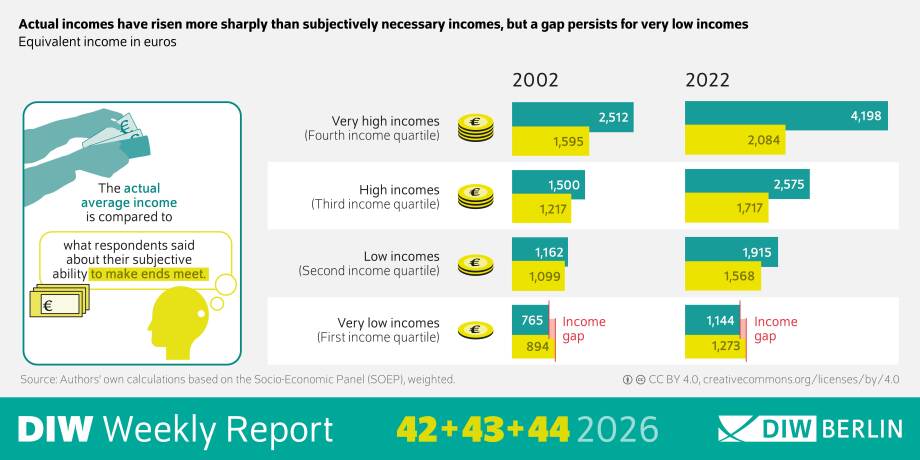
Infographic for Zinn, Sabine, Jürgen Schupp (2026): More and More People Feel Their Income Is Sufficient. DIW Weekly Report 42-44/2026, 305–313.
Pandemic-related school restrictions primarily affected mothers of primary school children
During school closures and restricted school operations in the COVID-19 pandemic, mothers with primary-school-aged children in particular reduced their labor market participation. In DIW Weekly Report 34/35/2026, Blanka Imre, Markus M. Grabka, Oskar Breer, and Neil Murray show that full-time employment among these mothers declined by four to five percentage points, while fathers partly increased their labor market participation. Married full-time working mothers were especially affected. The authors therefore advocate better childcare provision and more flexible working-time arrangements to strengthen work-family reconciliation.
The study was also covered by media outlets including the Berliner Morgenpost.
READ THE DIW WEEKLY REPORT (PDF, 243.01 KB)
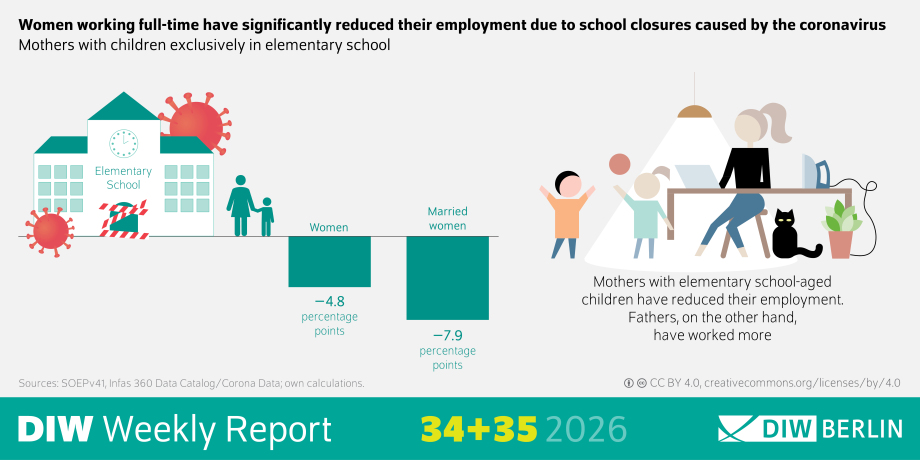
Infographic for Imre, Blanka, Markus M. Grabka, Oskar Breer, Neil Murray (2026): School Restrictions during the COVID-19 Pandemic Reduced Women’s Labor Supply. DIW Weekly Report 34/35/2026, 521–527. (Audio) interview with Blanka Imre (DIW).
Climate concerns continue to rise
Concern about the consequences of climate change has continued to increase in Germany in recent years, even though the COVID-19 pandemic and energy crisis shifted media attention to other issues. Based on SOEP data, Daniel Graeber, Laura Schmitz, and Franziska Holz show in DIW Weekly Report 18/19/2026 that younger people in particular are concerned about the climate crisis. Their conclusion: public attention may fluctuate, but concern about climate change remains high.
READ THE DIW WEEKLY REPORT (PDF, 0.59 MB)
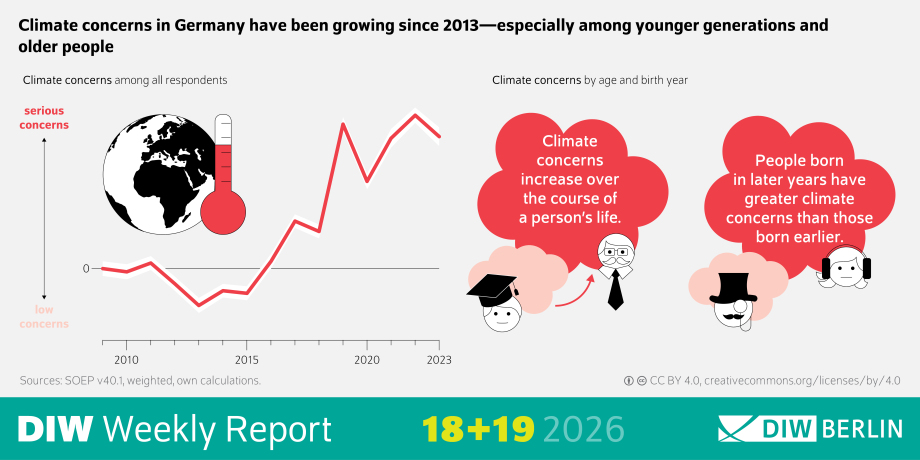
Infographic for Graeber, Daniel, Laura Schmitz, Franziska Holz (2026): Climate Concerns Matter More and More to Germans. DIW Weekly Report 18/19/2026, 287–294. (Audio) interview with Kristin Trautmann (DIW).
External Publications
Concerns about immigration explain support for the AfD far better than perceived disadvantage
Concerns about immigration are by far the strongest predictor of support for the AfD. By contrast, evidence that material deprivation or fears of downward mobility are the main explanatory factors is much weaker.
This is the conclusion reached by Martin Schröder, Moritz Rehm, and Anja Röcke on the basis of SOEP data.
READ THE FULL PAPER (PLoS One). The study was also covered by media outlets including the Frankfurter Allgemeine Zeitung, BILD.de (both accessible to subscribers), and Münchner Merkur.
Supplementary retirement savings fail to reach many households
Private and occupational pension saving are unevenly distributed in Germany. People with low incomes, interrupted employment histories, and lower levels of education are considerably less likely to save additionally for retirement.
This is the conclusion reached by Peter Haan, Johannes Geyer, and Marcus Borlinghaus of DIW Berlin using SOEP data. The authors warn that voluntary retirement saving systems may reinforce rather than reduce inequalities in old age.
READ THE FULL DIW WOCHENBERICHT (PDF, 2.62 MB )
Health conditions for longer working lives are deteriorating
Younger generations may reach higher retirement ages in poorer health than today’s older workers.
This is indicated by a study from Hannover Medical School (MHH), which analyzes SOEP and SHARE data among other sources. The findings also reveal growing inequalities in healthy life years between educational groups.
READ THE FULL PAPER (European Journal of Public Health). The study was covered, among others, by Deutsches Ärzteblatt and Hannoversche Allgemeine (accessible to subscribers).
Who helps more? It depends on the situation
People with higher incomes donate money more often, while people from lower social strata are more likely to provide direct personal assistance when support is needed in face-to-face situations. This is the conclusion of a study by Kühne Logistics University that combined a meta-analysis of around 160 studies involving approximately 680,000 individuals with analyses based on the German Socio-Economic Panel (SOEP). The findings suggest that people with lower social status often rely more strongly on mutual support, while wealthier individuals have greater financial resources available for donations.
READ THE FULL PAPER (Journal of Experimental Social Psychology). The study was covered, among others, by the Rheinische Post (accessible to subscribers).
Personality is less stable than people think
Personality traits change over the course of life to a similar extent as, or even more than, income, health, or life satisfaction, and may also be shaped by career success. Respondents substantially underestimated these changes. This is demonstrated by an international analysis of eight longitudinal studies involving around 167,000 individuals, including SOEP.
READ THE FULL PAPER (Psychological Bulletin). The study was covered, among others, by the Berliner Zeitung.
A second study involving SOEP examines what may drive such changes. The analysis of eleven longitudinal studies with around 134,500 participants shows that rising income is associated in the long run with higher conscientiousness and emotional stability, but lower extraversion. Conversely, certain personality traits also predict later income trajectories.
READ THE FULL PAPER (Communications Psychology). The study was reported on, among others, by WirtschaftsWoche.
Wealthy individuals account for a disproportionate share of emissions
The wealthiest ten percent of Germany’s population are responsible for around 66 percent of wealth-related greenhouse gas emissions while owning 62 percent of net wealth. This is the conclusion of a new study linking SOEP wealth data with sectoral emissions data from 2019. The findings indicate that emission responsibility is distributed even more unequally than wealth itself and is considerably more concentrated than emissions based on income or consumption.
Staff News keyboard_arrow_up
Appointments
Sabine Zinn has been appointed by the Federal Ministry for Education, Family Affairs, Senior Citizens, Women and Youth as an initiator and member of the Monitoring Panel of the National Action Plan (NAP) "New Opportunities for Children in Germany”.
Philipp M. Lersch has been appointed to the Editorial Board of the Journal of Marriage and Family beginning in 2027.
Successful Promotions
Viola Hilbert, formerly a research associate and currently a visiting researcher at SOEP, successfully defended her dissertation, “Where Does Wealth (Inequality) Come From? Three Empirical Essays on the Accumulation and Distribution of Wealth,” on October 26. The dissertation was supervised by Charlotte Bartels, also formerly a research associate and currently a visiting researcher at SOEP, and Melanie Kraus (both University of Leipzig). We congratulate Viola on this impressive achievement!
Further Awards
SOEP receives infrastructure award
At the beginning of November, SOEP was honored with the Infrastructure Prize for Sociology awarded by the Kohli Foundation. The prize recognizes SOEP’s long-standing contribution to social science research and its importance as a research infrastructure for the international scientific community.
READ THE FULL ARTICLE (only in German)
Prof. Dr. Sabine Zinn (center) with Prof. Dr. Isabell Stamm, Deputy Chair of the Board of the Kohli Foundation (left), and Prof. Dr. Michaela Kreyenfeld of the Hertie School (right) at the 2026 Kohli Award ceremony.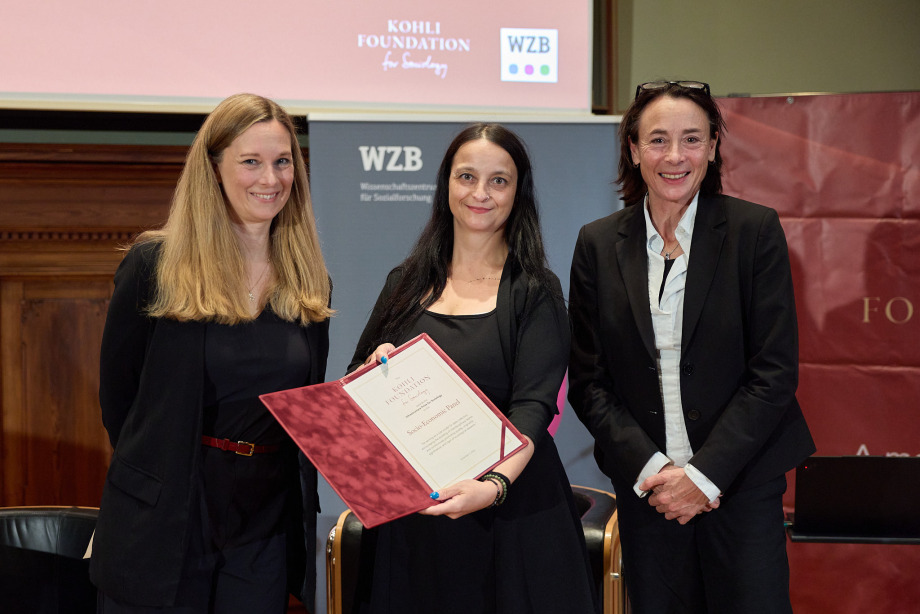
© Bernhard Ludewig
Welcome to SOEP
Sonja Marttinen has been a doctoral researcher at SOEP since October 1. Her research focuses on inequality, public finance, and political economy.
Markus Lynum, a doctoral researcher at Oslo Metropolitan University, will be a Visiting Researcher at SOEP until summer 2027. His research focuses on social inequality, class structures, and household finances, particularly wealth accumulation, financial practices, and intergenerational inequality.
Dr. Emily Frank, a postdoctoral researcher at Hannover University of Applied Sciences and Arts, will be a Visiting Researcher at SOEP until May 2029. Her research examines quantitative approaches to studying the determinants of migrants’ mental health and their experiences of citizenship and belonging.
A warm welcome to all!
SOEP Farewells
Juliane Zenker left SOEP at the end of July and is now a researcher at the Chair of Development Economics headed by Prof. Dr. Andreas Fuchs and a Dorothea Schlözer Fellow at the Faculty of Business and Economics at the University of Göttingen.
Julian Axenfeld also ended his work at SOEP on September 30 and now works at the Federal Statistical Office of Germany.
Both remain affiliated visiting researchers at SOEP.
Lorenz Meister left SOEP at the end of August and is now a postdoctoral researcher at the University of Oxford and a Non-Stipendiary Research Fellow at Nuffield College.
We wish all former colleagues every success in their future endeavors!
Community News keyboard_arrow_up

New: The Luxembourg Consumption Study (LCS)
In September 2026, the LIS Cross-National Data Center in Luxembourg launched the Luxembourg Consumption Study (LCS), a new database of harmonized household consumption microdata. Complementing the LIS (income) and LWS (wealth) databases, it enables joint comparative analyses of income, consumption, and wealth across countries. The LCS consumption measure includes imputed rents for owner-occupiers and rent-free households and focuses on what households consume, making living standards comparable across tenure groups, household types and countries. The data are available to registered users via LIS's remote-execution system.
Successful Visiting Stays: Alfonso Langastro and Thomas Meissner at SOEP
Alfonso Langastro, a doctoral researcher at the European University Institute (EUI) in Florence, visited SOEP in October 2026 as a visiting researcher. During his stay, he exchanged ideas with SOEP researchers on current topics in labor market and mobility research and worked on a joint research paper. MORE INFORMATION
Dr. Thomas Meissner, Associate Professor at the Department of Microeconomics and Public Economics, School of Business and Economics, Maastricht University, was a Visiting Researcher at SOEP at DIW Berlin from June 11 to July 19, 2026. During his stay, he engaged in exchanges on current questions in empirical economic and social research and collaborated on shared research topics. MORE INFORMATION
New Webinar Series on Panel and Survey Methods
A new webinar series, New Data Spaces | Dialogues, has been launched to bring together researchers, survey methodologists, representatives of organizations, and users of panel data. Topics include methodological innovations, novel survey designs, and the integration of new data spaces. The webinars are held in German or English and participation is free of charge. The next webinar will be held on 7 December.
Leibniz Open Science Day 2026
On November 17, the third Leibniz Open Science Day will take place at the Leibniz Association headquarters in Berlin under the theme “Scientific Rigor and Collaborative Research in the Age of AI.” The program includes contributions on Open Science, replication and reproducibility, research quality, and the opportunities and challenges of AI in the social sciences. Levent Neyse is a member of the organizing committee.
Call for Abstracts: Computational & Experimental Sociology Spring Conference
The first DGS Spring Conference of the Section Computational and Experimental Sociology, entitled “Bridging Survey & ABM: Big Data and Social Simulation in the Era of AI,” is aimed at researchers interested in computational social science and modeling. The conference is jointly organized by Knut Petzold, Hawal Shamon, Sabine Zinn, and Marc Hannappel and will take place at the University of Koblenz on March 12 and 13, 2027. For the full Call for Abstracts, please contact one of the organizers listed here. The submission deadline is November 30, 2026.