DIW Economic Outlook Summer 2025
Tariff chaos overshadowing the global economy; fiscal package bolstering the German economy
- German economy is on the brink of recovery; growth of 0.3 percent and of 1.7 percent expected for 2025 and 2026; DIW Berlin is increasing its forecast
- Federal investment package to provide stimuli; effects in 2025 will be minimal due to planning delays, but a noticeable flow of funds is expected in 2026
- Consumption and front-loaded exports to the US due to expected tariffs supported the economy in the first quarter of 2025, but the economy will likely cool down in the second half of the year
- Labor market situation remains tense, unemployment will rise for the time being; inflation stagnating at 2.1 percent in 2025 and will increase to 2.2 percent in 2026
- Geopolitical tensions and protectionist policies are weighing on the global economy: Growth of 3.3 percent in 2025 and of 3.4 percent in 2026 is expected
German Economy
Fiscal package providing hope for stronger domestic economy
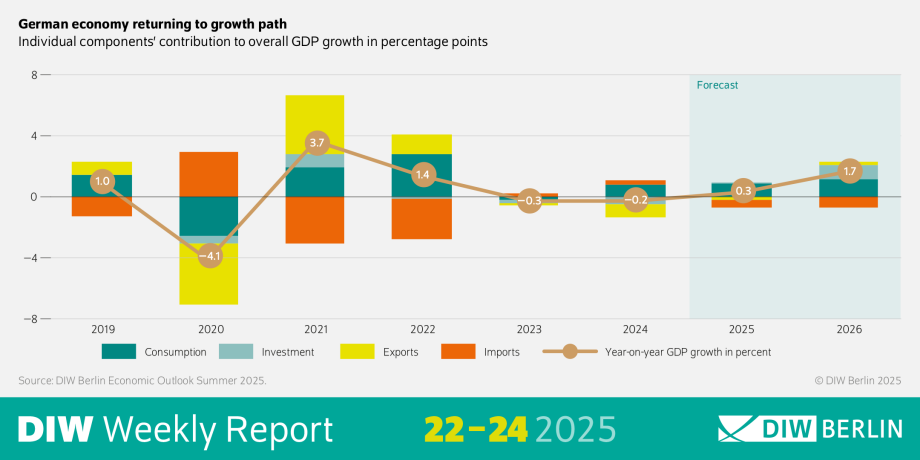
Despite the strong start to the year, the German economy remains mixed for the time being, before the long-awaited upturn is likely to set in towards the end of the year. The DIW Berlin forecasts gross domestic product growth of 0.3 percent for this year and 1.7 percent for 2026 (see table “Key economic indicators for Germany” below).
© DIW Berlin
With this, the institute is significantly raising its forecast. The expansive fiscal policy is counteracting the effects of higher trade tariffs. From the multibillion-euro fiscal package, substantial funds are expected to start flowing from next year onward, stimulating consumption and investment. This year, however, the new fiscal leeway will hardly have an impact, as the 2025 public budget is not expected to be adopted until autumn, delaying planning, approval, and tendering procedures.
Even in 2026, the disbursement of funds is likely to remain well below the average annual investment amount of around 40 billion euros for infrastructure. Nevertheless, the positive effects will be noticeable, offsetting the dampening influence of the structurally weak industrial sector and the foreign trade burdened by high tariffs.
However, risks to economic development remain — ongoing geopolitical tensions and a possible escalation of the trade conflict between the United States and the EU.
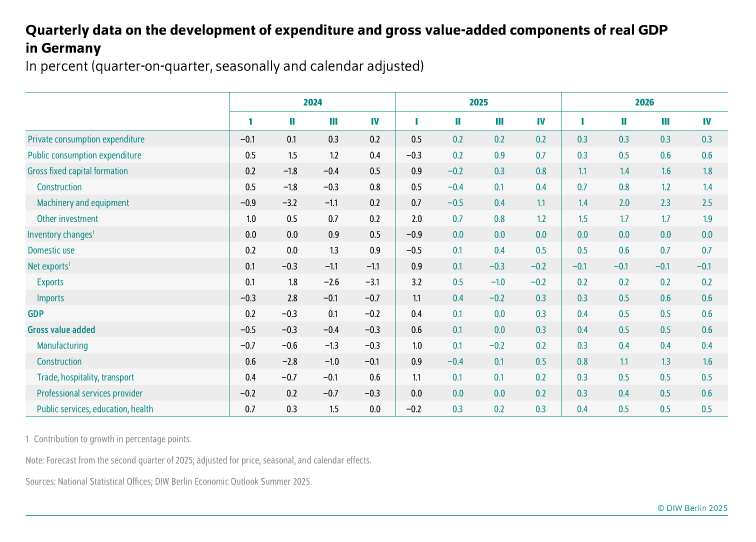
The German economy got off to a strong start this year, mainly because goods exports to the U.S. were brought forward in anticipation of the tariff increases announced by the U.S. government. Private consumption also rose, while the seasonally adjusted savings rate fell unusually sharply. There were glimmers of hope for the manufacturing sector, although sentiment among service providers has recently deteriorated somewhat.
In the current quarter, only minor advance export effects are expected, and not as pronounced as in the first three months. Private consumption is likely to continue growing, though at a slower pace. The labor market remains tense, unemployment is rising, and many fear losing their jobs.
In the second half of the year, the economy is expected to cool slightly before regaining momentum toward the end of the year as fiscal measures gradually take effect. Inflation will remain stable at 2.1 percent this year and is expected to rise slightly to 2.2 percent in 2026.
“The German economy started off the new year with some momentum. However, this does not change the structural issues such as declining competitiveness and the shortage of skilled workers. One ray of hope is the investment package for infrastructure which should have noticeable effects in 2026.” Geraldine Dany-Knedlik, Head of Forecasting and Economic Policy Team
© DIW Berlin
Global Economy
Effects of Trump’s tariff policy becoming visible, especially in the United States
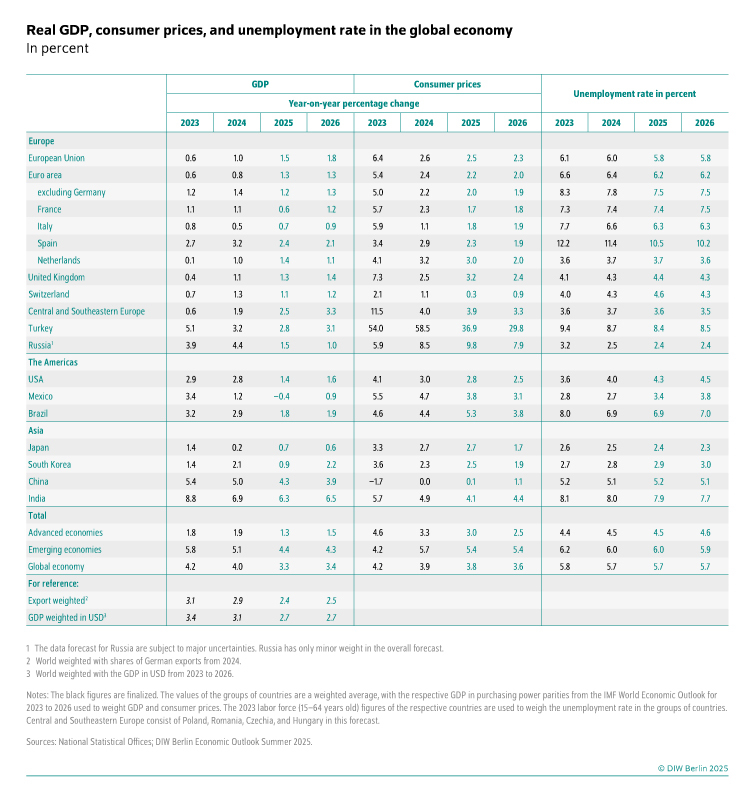
Some EU member states and thus the entire eurozone are also likely to benefit from the overall positive development in Germany. Overall, however, the global economy remains overshadowed by US tariff policy. This will probably hit the US itself the hardest, with its economy expected to grow by only 1.4 percent this year and 1.6 percent next year, down from 2.8 percent last year. The global economy is expected to grow by 3.3 percent this year and 3.4 percent next year.
© DIW Berlin


