SOEPnewsletter March 2026
Dear SOEP Community,
In the current issue of the SOEPnewsletter 2026, you will find all the information you need about the latest data releases (see “Data Service”) as well as upcoming and past events (see “News and Events”).
As usual, we present a selection of interesting new publications based on SOEP data (see “Publications”) and provide news about our SOEP staff (see “Staff and Community News”).
We hope you enjoy reading!
Best regards
Your SOEP Knowledge Transfer Team
Data Service keyboard_arrow_up
New Dataset: SOEP-Core Data 1984-2024 (v41) available now
All registered data users can now access the latest data v41 (DOI: 10.5684/soep.core.v41eu) via our online order form.
In German: http://www.diw.de/SOEPbestellung
In English: http://www.diw.de/SOEPorder
Key updates for v41:
- New samples:
-
S 2024 Refreshment (refresh of the general population, >5,000 households)
-
M8d IAB-SOEP 2024 Refreshment (non‑EU migration, +300 households)
-
M10 IAB-SOEP 2024 Refreshment (EU nationals, +2,000 households)
-
- Release of SOEP LEE2 establishment data (2022/2024) and updated selfempl data (2020/2022/2024)
- New or revised variables in numerous modules (including PGEN, BIOL, PL), e.g., the new aggregated religion variable (“pgreli” in the dataset pgen)
- GRIPSTR bug fixed (variables gs04/gs05 were swapped)
- Revised weighting logic (including adjustments for migration samples and rounding of weights)
Further details on data delivery can be found as a supplied "WhatsNew" document in the data package or here.
Upcoming New Dataset: SOEP-IS Data 1984-2024 (v41) available soon
The data of the SOEP Innovation Sample from the survey year 2024 will be released soon (Mach/April). Now that the official embargo has ended, the innovative modules from 2023 will also be included in this release.
Further information can be found on the page for the current data version on our website, paneldata.org, and SOEP-IS-Companion.
The data can already be pre-ordered via the SOEP order form.
New Dataset: SOEP-CMI-ADIAB 7523 available now
The newest wave of the linked data product SOEP-CMI-ADIAB is now available. This data product includes not just Socio-Economic Panel data but also the integrated employment biographies administered by the Institute for Employment Research (IAB). The new wave includes data of SOEP respondents who consented to the linkage up to 2023. Overall, it comprises linked data of 44162 individuals.
Further information with regard to the data or data access can be found on the SOEP website or directly at the research data center of the IAB.
New Dataset: The Wave 2 Scientific Use File of the German Social Cohesion Panel (SCP) available now
The SCP is a longitudinal study that captures multiple aspects of social cohesion in Germany. It is based on a representative population sample drawn from the German population registers and was carried out for the first time in 2021 (n=17,027). In addition to randomly selected anchor persons, the annual survey also targets their adult household members. The SCP is funded by the Federal Ministry of Research, Technology and Space (BMFTR), led in cooperation by the Research Institute Social Cohesion (RISC) and the German Socio-Economic Panel (SOEP), and implemented by the survey institute infas.
The SCP 2021-22 W1-2:
The dataset "German Social Cohesion Panel 2021-22 – Wave 1-2" (DOI: 10.60532/scp.2021-22.w1-2.v1) includes survey data and generated indicators of the first and second panel waves. The new data release includes, among others:
- The data of the second wave (n=8,642, including 274 new household members surveyed for the first time in this wave).
- Updated nonresponse weights for all waves, which now also include the school degree as an additional raking variable.
- Newly generated variables, such as the RISC milieu classifications.
A detailed overview of all changes can be found in the changelog.
Data Access:
The SCP can be ordered at the RISC Research Data Centre (RDC-RISC) by all post-doctoral researchers affiliated with a scientific institution. For that purpose, please set up a data user account at https://fgz-risc-data.de/en/registration if not yet done. You can use this account in the future to order all Scientific Use Files available at the RDC-RISC.
Account holders (primary users) may share the data with researchers under their supervision (secondary users). Secondary users must be listed in the primary user's data user account and must sign a privacy policy, which must be archived by the primary user.
We would like to remind you that the data are provided for scientific use only.
News and Events keyboard_arrow_up
News
News from SOEP Survey Management: Field Start 2026
In March, the Leben in Deutschland (Living in Germany) study of the SOEP will launch its 43rd survey wave. Of the SOEP Core samples, 55% of households will be invited to participate via the face‑to‑face method (CAPI) and 45% via the online mode (CAWI). For the first time, this allocation was based on SOEP’s own data analyses, after an initial plan for 2025 that would have assigned households randomly with a 50/50 split between CAPI and CAWI. SOEP staff plan to present results from this mode‑assignment experiment during the 2026 conference year.
The new survey wave of the IAB‑BAMF‑SOEP Survey of Refugees in Germany will also begin in March. This marks the 11th survey year of this collaborative study.
Project Extension: SUARE 2026–2029
The longitudinal study on refugees from Ukraine in Germany (SUARE) was granted a second funding phase by the German Research Foundation (DFG) covering 2026 to 2029 (SUARE II). The project, led by Sabine Zinn, Elena Sommer, Louise Biddle, and Adriana Cardozo Silva, examines the specific characteristics of Ukrainian forced migration, shaped by legal frameworks such as the EU Temporary Protection Directive and by distinct family structures.
Over the next three years, the study will focus specifically on the long‑term effects on the education and health of children and adolescents, as well as on the role of discrimination experiences within family and school contexts. Through the use of innovative, AI‑supported survey methods, SUARE II will make an important contribution to understanding integration trajectories, including in comparative perspective with other migrant groups.
Upcoming Events
Working successfully with SOEP data: Register now for the next SOEPcampus event
SOEPcampus workshops are helpful for both newcomers and advanced users of SOEP data. In addition to hands‑on guidance on preparing the data, participants can deepen their SOEP knowledge and receive direct support in processing their own dataset.
Our regular program includes both online and in‑person workshops – here are the upcoming dates:
Learn to Use the SOEP Over Lunch: Online Workshop Series in March/April 2026
This online workshop will take place on March 18 and 25 and April 1, 2026, each from 12:00 to 13:30 (CET). Participants will be introduced to the content of the study, the data structure, sample selection, weighting strategy, and will receive an overview of the study documentation.
Target group: Researchers at all qualification levels who plan to work with SOEP data in the future or who are currently at an early stage of a SOEP‑based data analysis.
Language: English
Registration: Please register by March 17, 2026, via email to Janina Britzke, including your name and institution.
The participation link and any workshop materials will be sent out during the week before the first session in March.
Further workshops are planned for October and November 2026. More information will be provided in the next issue of the SOEPnewsletter and on our website. If you are interested in hosting a SOEPcampus workshop at your organization, please contact Cristóbal Moya (cmoya@diw.de).
People and Papers keyboard_arrow_up
Publications
More cohesion on climate issues?
Based on the dataset of the second wave of the Social Cohesion Panel (more information under Data Service), the Research Institute for Social Cohesion (FGZ) published its Second Social Cohesion Report on November 13, 2025. The report is titled “(Im)possible Transformation? Social Cohesion and Attitudes Toward Climate Change in Germany.” Since 2020, the institute has been using various data sources to research what unites and divides people in Germany.
The vast majority (71 percent) of Germans would like to see their politicians do much more to protect the climate, with 83 percent reporting they are worried about climate change. At the same time, many people are concerned about the potential economic consequences of climate policy. Only eight percent are clearly opposed to ecological transformation – a small but potentially divisive group.
A central finding of the report is the identification of five “climate types” within German society:
- The Determined (18 percent), who are strongly convinced of the dangers of climate change and the need for a socio‑ecological transformation;
- The Concerned (18 percent), who worry equally about climate change and about potential negative consequences of climate protection;
- The Supportive (31 percent), who want more climate protection but also have certain concerns about transformation;
- The Indifferent (25 percent), who hold neutral or undecided views; and
- The Rejecting (8 percent), who view climate change as less dangerous and disagree with climate protection measures.
The findings attracted considerable media attention (all in German): The press conference was broadcast live on Phoenix, and major news outlets—including tagesschau24, Deutschlandfunk, and the FAZ (accessible to subscribers)—reported on the results.
You can find out which climate type you are at https://fgz-risc-data.de/klimatypenrechner.
Do regional inflows of refugees affect the mental health of the native population?
A recent study by Prashant Bharadwaj, Daniel Graeber, Stephanie Khoury, and Christian P. R. Schmid investigates how the allocation of asylum seekers affects the mental health of the resident population in Germany and Switzerland. The findings were published in the Journal of Development Economics.
For Germany, the analysis combines quasi‑random regional allocations of asylum seekers with administrative health insurance data and SOEP data on self‑reported mental health. The results show no economically meaningful changes in depressive or anxiety‑related symptoms among native residents in regions with higher inflows of asylum seekers.
The authors conclude that public debates about migration may have stronger effects on perceived stress and anxiety than the actual local presence of refugees.
Bharadwaj, Prashant, Daniel Graeber, Stephanie Khoury, and Christian P. R. Schmid. 2026. Asylum seekers and host country mental health: Evidence from Germany and Switzerland. Journal of Development Economics 178 (January 2026), 103579.
http://doi.org/10.1016/j.jdeveco.2025.103579
How has the distribution of income in Germany changed since reunification?
A recent study published in the European Economic Review by Stefan Bach, Charlotte Bartels, and Theresa Neef examines the distribution and composition of national pre‑tax income in Germany from 1992 to 2019, using SOEP data, income tax records, and national accounts. Their results indicate an increase in national pre‑tax income inequality since the 1990s, though to a lesser extent than previously assumed.
A comparison with the United States and France shows greater similarities with the United States in terms of the structure and concentration of top incomes. Around half of the top one percent of income earners are self‑employed in labor‑intensive occupations outside corporate structures (in France, more commonly within corporations). The concentration of national pre‑tax income in Germany also resembles that of the United States and is higher than in France.
This analysis provides policymakers and researchers with nearly three decades of empirical evidence to support informed debates on tax policy, social security, and labor market structures.
Bach, Stefan, Charlotte Bartels, and Theresa Neef. 2026. The distribution of national income in Germany, 1992–2019. European Economic Review 181 (January 2026), 105149.
http://doi.org/10.1016/j.euroecorev.2025.105149
What is the added value of linking SOEP data with administrative health records?
This contribution, published as a Ruhr Economic Paper, by Alexander Lepe, Ingo Kolodziej, and Sabine Zinn examines gaps in Germany’s pandemic data infrastructure revealed during COVID‑19. The authors argue that linking the Socio‑Economic Panel (SOEP) with administrative health data would improve the state’s ability to track infectious diseases and their spread within the population.
Drawing on insights from the RKI‑SOEP Study, the authors illustrate the benefits of linking extensive household survey data with infection‑related health data and discuss why such linkages remain limited in Germany. They outline practical implementation pathways and highlight the potential of data integration: it could enable faster and more balanced insights during future public health crises while also enriching health and social research more broadly.
Lepe, Alexander, Ingo Kolodziej, and Sabine Zinn. 2025. Pandemic-Ready Data: Linking the Socio-Economic Panel with Administrative Health Records (PDF, 300.35 KB). SOEPpapers 1232. Berlin: DIW Berlin.
Is there public support for a social media ban up to age 16?
A new SOEP Flash Survey, presented in DIW Weekly Report 10/2026 (PDF, 438.15 KB), shows: while around 90% of the population see risks in children and adolescents using social media, only 50% support a ban up to age 16. A ban up to age 12, however, receives broad support from 71%.
More popular than age restrictions are differentiated protective measures: over 90% support stronger media literacy education, mandatory platform regulations, and increased parental oversight. A smartphone ban in schools is also strongly supported (59%).
Strikingly, attitudes in households with children aged 9 to 16 differ little from those without children. Younger respondents (“Gen Z”) and people with lower education levels are somewhat more likely to see opportunities in social media.
Study author and Head of Survey Methodology and Management at SOEP, Christian Hunkler, emphasizes:
“Social media are perceived as mostly risky by the population, yet there is also awareness of their benefits. The debate is therefore much more nuanced than blanket calls for bans suggest.”
In light of the survey results, the authors argue for balanced regulation—focusing on education, platform responsibility, and moderate restrictions.
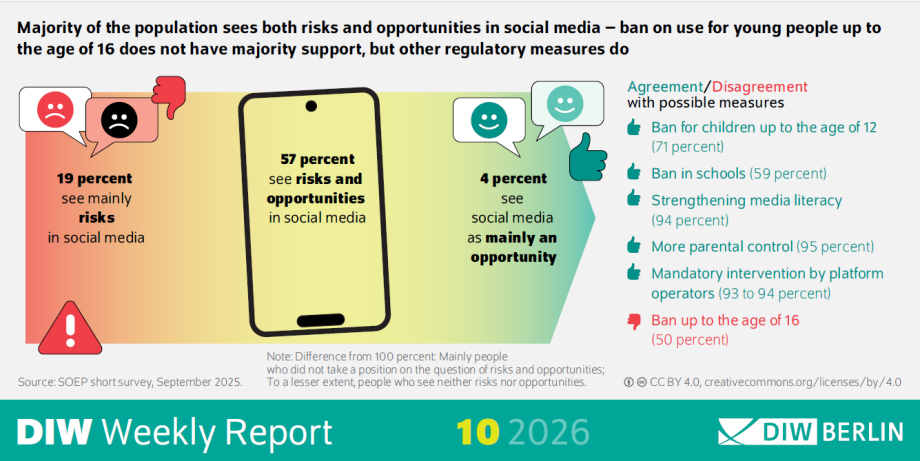
Infographic for Dollmann, J., Christian Hunkler, Nicolas Legewie, Julian B. Axenfeld, Andreas Franken and Felix von Heusinger. 2026): Social Media: Population Favors Regulation—but Ban Only for Those up to the Age of 12. DIW Weekly Report 10/2026, 79-88. (Audio-)Interview (only in German) with Christian Hunkler (DIW).
How much net income is needed for a dignified life in Germany?
A recent SOEP Flash Survey reveals significant gaps between the legally defined subsistence minimum and societal expectations. While many people consider their own income sufficient, respondents report that a dignified life is only possible starting at around €2,000 in net equivalized household income. Below this threshold, two‑thirds say a dignified life is not achievable.
Currently, the legally defined subsistence minimum, including housing and heating costs, ranges between €1,000 and €1,200 for single adults, depending on location. However, SOEP data show that the public’s subjective expectations are much higher. People with low incomes, part‑time or marginal employment, and younger age groups assess their situation particularly critically.
Assessments of the Bürgergeld benefit level also vary, those without experience receiving Bürgergeld are more likely to consider it adequate, whereas only 3% of current recipients agree.
Presented in DIW aktuell 118 (PDF, 497.81 KB), these findings offer important guidance for the upcoming 2026 recalibration of benefit levels. They highlight the gap between societal expectations and legal definitions—and the importance of a socially accepted understanding of what constitutes a “dignified life.”
Schupp, Jürgen and Sabine Zinn. 2026. Mehrheit sieht würdevolles Leben erst oberhalb von 2000 Euro netto – und damit klar über dem staatlichen Existenzminimum. DIW aktuell Nr. 118. Berlin: DIW Berlin.
Staff News keyboard_arrow_up
DIW Berlin Appoints Sabine Zinn to the Executive Board
As of December 1, 2025, Sabine Zinn has not only formally taken over the leadership of the Socio‑Economic Panel (SOEP), but has also officially joined the Executive Board of DIW Berlin.
With her recognized expertise in empirical social research and her many years of experience in major panel studies, she contributes substantially to the continuous development of the SOEP—one of the most important longitudinal studies in the social sciences worldwide. At the same time, she will now contribute this perspective even more strongly to the strategic orientation of the institute.
With this step, DIW Berlin underscores the importance of excellent research infrastructures and evidence‑based policy advice for its work.
Research Visit: Thomas Rieger at UC Berkeley
From January to May 2026, Thomas Rieger is visiting UC Berkeley for a research stay with Emmanuel Saez. He receives additional financial support through a DAAD scholarship and the DIW Graduate Center.
Jürgen Schupp enters well-deserved retirement
In December 2025, SOEP celebrated Jürgen Schupp and his (then) upcoming retirement. During the ceremony, he humorously referred to himself as SOEP's “dinosaur.”

Jürgen Schupp (former SOEP Director) next to Marcel Fratzscher (DIW President) at the SOEP Christmas party in 2025 © DIW Berlin
During his 41 years at DIW Berlin, he initially worked as a research assistant, then as the survey manager in the infrastructure unit. Subsequently, he was its director for many years. His impressive career as a researcher was intertwined with SOEP from the very beginning: after graduating with a degree in sociology from Johann Wolfgang Goethe University (now Goethe University) in Frankfurt am Main in 1983, he worked as a research assistant at Collaborative Research Center 3, “Microanalytical Foundations of Social Policy,” in a subproject based at Goethe University. There, he became enthusiastic about another newly launched project of Sfb 3 (led by SOEP founder and DIW President Hans-Jürgen Krupp), which was the forerunner of SOEP.
Jürgen Schupp moved to DIW Berlin at the end of 1984 and played a key role in the successful early expansion of SOEP in the former GDR. In 1994, he earned his doctorate from Ruhr University Bochum. In 2006, the Department of Political and Social Sciences at Freie Universität Berlin appointed him honorary professor of sociology.
Starting in 2004, he was SOEP’s deputy head. In February 2011, he took over the interim management of the research-based infrastructure unit SOEP together with Joachim R. Frick. In 2013, he was appointed university professor (W3) for sociology, specializing in empirical social research, at the Free University of Berlin in cooperation with DIW Berlin. He remained director of SOEP until 2017. Under his scientific leadership, SOEP repeatedly received the rating “excellent” in various evaluations. His ongoing interest in scientific knowledge led to the continuous introduction of innovations at SOEP on his initiative, which promoted scientific excellence, thus forming an important pillar of SOEP's success.
We wish Jürgen Schupp the best of health and all the best for the next stage of his life. In keeping with Trude Herr's saying, “You never really leave,” it should be noted that Jürgen Schupp now holds the title of “DIW Honorary Fellow”—thus his expertise will remain available to DIW Berlin and SOEP.
Uta Rahmann leaves DIW Berlin
It is hard to imagine SOEP without her – Uta Rahmann has been an integral part of the team since July 1999. She began developing SOEPlit and assisting the then team assistant, Christine Kurka. Early on, she developed a remarkable skill for transforming Gert G. Wagner’s dictated notes and handwritten comments into clean digital text.
Over the years, she took on numerous responsibilities: maintaining and further developing the SOEP website – from custom Python scripts to multiple CMS relaunches; organizing SOEP trainings (the predecessors of today’s SOEPcampus events, together with Joachim Frick); co‑organizing SOEP conferences; and supporting the SOEPpapers and SOEP Survey Papers series. She also contributed to many other areas, including secretariat duties, the SOEPhotline (today: SOEP Community Management), data distribution, support with project proposals and evaluations, as well as initiatives to improve internal information flows.
She initially supported the SOEPnewsletter through editing work for Elke Holst and later took it over entirely. In 2012, during the institute’s evaluation, she briefly stepped in as an advisor to the Executive Board before returning to SOEP.
For many years, she has also been active on the Works Council, serving as its chair in recent years – another example of her long‑term and deeply committed engagement for the institute.
On March 31, 2026, after more than 26 years, Uta will leave SOEP. We wish her all the very best for her next – certainly just as active – chapter in life, and above all, good health!
Appointments
Philipp M. Lersch has accepted a W3 professorship at Humboldt University of Berlin in cooperation with DIW. We warmly congratulate him and are delighted that Philipp will continue his excellent research on wealth inequality at SOEP.
Successful Promotions
On December 10, Neil Murray successfully defended his dissertation with the title “The Dynamics of Risk Preferences: Empirical Perspectives on Adaptation and Behavior” at Freie Universität Berlin (FU Berlin).
The committee included Prof. Dr. Carsten Schröder (supervisor and first reviewer, FU Berlin), Prof. Dr. Jan Marcus (second reviewer, FU Berlin), Prof. Natalia Danzer, Ph.D. (FU Berlin), Prof. Dr. Peter Mohr (FU Berlin), and Lorenz Meister (minute-taker, FU Berlin).
On December 11, Cristóbal Moya successfully defended his dissertation with the title “The Politics of Unjust Inequalities: From Injustice Perceptions to Protest and Redistribution” at Bielefeld University.
The committee included Prof. Dr. Carsten Sauer (supervisor and first reviewer, Bielefeld University), Prof. Dr. Stefan Liebig (second reviewer, FU Berlin), Prof. Dr. Sonja Blum (committee chairmanship, Bielefeld University) und Dr. Robin Schulze Waltrup (Bielefeld University).
We congratulate both on their impressive achievements!
Further Awards
Sascha dos Santos wins NEPS Publication Award 2025
Sascha dos Santos and his co-authors were honored for their contribution to the European Sociological Review entitled "Does training beget training over the life course? Cumulative advantage in work-related non-formal training participation in Germany and the UK" by the interdisciplinary jury of the Leibniz Institute for Educational Trajectories (LIfBi) as one of this year's two winning teams of the NEPS Publication Award. The NEPS (National Education Panel Study) collects longitudinal data on educational processes and skills development in Germany.

Sascha dos Santos gives keynote speech at the 10th International NEPS Conference © LIfBi
The award ceremony took place during the 10th International NEPS Conference at LIfBi in Bamberg. Sascha dos Santos gave a keynote speech on the award-winning comparative study on the cumulative benefits of work-related continuing education measures in Germany and the UK, which was also available online as part of the LIfBi Lectures series. For him, the NEPS Publication Award is a special recognition of the joint research work carried out by the team. At the same time, he sees it as a signal that, in times of technological change, education and labor market research must not stop at initial training but must consider continuing education processes throughout the entire working life to adequately understand social inequalities.
With Sascha dos Santos, a SOEP researcher has been selected as the NEPS Publication Award winner for the second time in a row after Emilija Meier-Faust in 2024.
DIW Berlin Publication Awards 2025: Multiple Award Winners from SOEP
In December 2025, DIW Berlin awarded the three best Wochenbericht articles as well as the best journal publications of the year 2025. (Former) SOEP researchers were represented with three awardees across two categories:
- Best Publication:
Mathis Herpell et al. 2025. The impact of private hosting on the integration of Ukrainian refugees in Germany. Nature Human Behaviour 9, 2249–2260. - Wochenbericht Article (3rd place):
Ellen Heidinger and Philippa Cumming. 2025. Willkommensgefühl bröckelt: Geflüchtete nehmen Diskriminierung am Arbeits- und Wohnungsmarkt wahr. Berlin: DIW Berlin.
Congratulations on these outstanding achievements!
Welcome to SOEP
Since February 1, Sophia Fauser is a researcher in the WEALTHRAJECT research project and the “Life Course and Inequality” research group at SOEP. Her research focuses on labor market outcomes and social inequality, applying methods of longitudinal data analysis.
SOEP Farewells
Miriam Gauer ended her position at SOEP on December 31, 2025, but will remain connected to the project as a doctoral researcher (BAGSS).
Barbara Stacherl also left SOEP at the end of last year and is now working as a postdoctoral researcher at the Institute of Health Economics at Leibniz University Hannover.
Angelina Hammon will leave SOEP on March 31, 2026, and will continue her work as a lecturer at the University of Bamberg.
All three will remain affiliated guest researchers at SOEP – so, to our great delight, this is not a farewell without seeing each other again.
We wish all departing colleagues nothing but the very best for the future!
Community News keyboard_arrow_up
Introducing ManyLabsDACH
ManyLabsDACH is a large-scale, community-driven crowd‑science project across the DACH region (Germany (D), Austria (A), and Switzerland (CH)) designed to maximize data comparability. The participating research teams develop and evaluate experimental designs to ensure that the highest‑rated study is implemented consistently across all locations using standardized materials and procedures. Supported by key organizations and research programs such as Lab² (funded by the Leibniz Association), the CRC Rationality and Competition (DFG‑funded), and the SOEP (DIW Berlin), ManyLabsDACH aims to connect around 20 experimental laboratories and collect a substantial dataset of approximately 5,000 observations.
For more information, please visit: https://www.manylabsdach.com
If you have any questions or would like to discuss the project, please feel free to get in touch with Levent Neyse or anybody on the ManyLabs DACH - Project Team.
Call for Papers: Advancing Reliability in the Social Sciences
The Journal of Economic Psychology invites submissions for a special issue on meta-science, open science, and collaborative research designs. We welcome empirical contributions that strengthen the reliability, transparency, and credibility of research in the social sciences.
Eligible submissions include replication and robustness studies, meta-analyses, crowd‑research designs (e.g., Many Labs), heterogeneity assessments, methodological meta-science (preregistration, reporting standards), expert‑informed approaches, and work on open‑science infrastructures. Studies on generalizability or innovative cumulative research approaches are also encouraged.
Submission deadline: May 31, 2026
For further information regarding this special issue, please contact the Guest Editors: Maja Adena (WZB Berlin Social Science Center; TU Berlin, Germany), Frank M. Fossen (University of Nevada-Reno, USA) or Levent Neyse (WZB Berlin Social Science Center; SOEP at DIW Berlin, Germany).
Call for Proposals: FlexFunds in the area of research data management (KonsortSWD)
KonsortSWD – NFDI4Society supports the further development and integration of tools for RDM and fund projects that contribute to the improvement, expansion or sustainable use of RDM tools, particularly for sensitive data.
The deadline for submission is April 15, 2026.
All further information, such as the evaluation criteria and formal requirements, as well as the application form, can be found on our website.

Appendix: External Events and CfPs keyboard_arrow_up
Call for papers: Annual workshop of the European Research Network on Transitions in Youth (TiY) – 9-11 September 2026, Mannheim (Germany)
The European Research Network on Transitions in Youth invites submissions for their 33rd annual workshop on Risks, Resilience and Opportunities: Youth Transitions in a Changing World. This year the workshop will be hosted by the University of Mannheim. Keynote speaker: Jan Stuhler, Professor of Economics at Universidad Carlos III de Madrid.
You are warmly invited to submit an abstract (no longer than 500 words) for a paper or poster via the conference website by March 15, 2026.
Workshop local organizers: Irena Kogan, Tamara Gutfleisch, and Markus Weißmann.
CfP 7. Forum “Higher Education and the Labour Market” (HELM)
We would like to draw your attention to the current call for papers for the 7th Forum “Higher Education and the Labor Market” (HELM), jointly organized by the DZHW and IAB, with a focus on “Intended and Unintended Consequences of Higher Education Reforms.”
The conference will take place June 23 and 24, 2026, in Nuremberg. The conference language is English. The deadline for submissions is March 31, 2026. Please send your abstract (max. 500 words) to helm@iab.de.
The complete Call for Papers can be found at https://eveeno.com/helm-2026.
German Stata Conference 2026
We would like to announce the 23rd German Stata Conference to be held Friday, June 19, 2026, at Internationales Begegnungszentrum der Wissenschaft München e.V.
All Stata users, from Germany and elsewhere or those interested in learning about Stata, are invited to attend. Presentations for any skill level are sought on topics that include the following: User-written Stata programs, case studies of research or teaching using Stata, discussions of data management problems, reviews of analytic issues, surveys or critiques of Stata facilities in specific fields and related topics.
The conference language will be English.
Conference Workshop June 18, 2026, Conference June 19, 2026
Scientific Organizers: Johannes Giesecke (Humboldt Universität), Ulrich Kohler (University of Potsdam), Christian Ganser (LMU Munich), Daniel Krähmer (LMU Munich)