SOEPnewsletter June 2025
Dear SOEP Community,
We are starting the summer with good news: The latest SOEP data (v40) are now published and can now be ordered (see “Data Service”). We are also very excited to announce that Sabine Zinn is officially designated by the DIW Berlin Board of Trustees as the Director of SOEP and to the DIW Berlin Executive Board (see “News and Events”).
In the second issue of the SOEPnewsletter 2025, you will find all the important information on the latest data releases (see “Data Service”), news from fieldwork and research, as well as upcoming and past events (see “News and Events“).
As usual, we present a selection of exciting new publications based on SOEP data (see “Publications“) and provide news about our SOEP staff (see “Staff and Community News”).
We hope you enjoy reading!
Best regards
Your SOEP Knowledge Transfer Team
P.S. Please also note our job offers: We are currently looking for a postdoc for the ERC project “WEALTHTRAJECT: Understanding Trajectories of Wealth Accumulation and Their Variability”.
Data Service keyboard_arrow_up
New Dataset: SOEP-Core Data 1984-2023 (v40) available now
All registered data users can now order the latest data v40 (DOI: 10.5684/soep.core.v40eu) via our online order form.
In German: http://www.diw.de/SOEPbestellung
In English: http://www.diw.de/SOEPorder
Important news for v40:
- New samples: With the migration sample M8c and the refugee sample M9, two new samples were added to the SOEP data in cooperation with IAB and BAMF.
- Several data set errors were fixed, weights updated, and variables integrated.
- There are three new data sets: YOUTHL, GKAL, and LKAL.
- There is now a template data set available to explore the linking possibilities of SOEP and FDZ—RV data.
Further details on data delivery can be found as a supplied "WhatsNew" document in the data package or here.
New Data Release: SOEP IS 2023
The SOEP Innovation Sample data for survey year 2023 is now available. After the official embargo, the innovative modules from 2022 are included in this release as well.
For more information, see the official website of the release, paneldata.org and SOEP-IS-Companion.
The data can be obtained via the SOEP order form.
Change in the methodological design of the SOEP-Core study
For this year's SOEP-Core study and the IAB-SOEP Migration Sample, we selected a push-to-web approach that had already been tested and scientifically evaluated in the British Understanding Society Panel (Going Online with a Face-to-Face Household Panel: Effects of a Mixed Mode Design on Item and Unit Non-Response | Survey Research Methods): A random 50% of all survey households were invited to self-administered online participation (CAWI), while the remaining 50% received an invitation to the usual face-to-face interview (CAPI). The CAWI start method was followed by a CAPI follow-up after eight weeks for those who did not respond to the invitation and reminders. With this change, the SOEP takes a step toward faster data collection and distribution.
Almost three months into the fieldwork, we draw a positive interim assessment and, therefore, now also plan a split of the start methods for the 2026 fieldwork. The experience acquired this year will inform Tailored Mode Design for next year, to ensure high response rates and maintain very high data quality. This entails analyzing for which households CAWI works well and for which personal interviews (CAPI) are more suitable. Based on these analyses, about 60% of households will receive an invitation to personal CAPI interviews in 2026, while ca. 40% will be invited to the online CAWI mode. Thus, SOEP continues to rely on the reputable CAPI method for more than half of all surveyed households, while at the same time utilizing the advantages of the CAWI.
News and Events keyboard_arrow_up
News
Sabine Zinn designated SOEP Director and member of the DIW Executive Board
The Board of Trustees of the German Institute for Economic Research (DIW Berlin) has designated social scientist Sabine Zinn to the DIW Executive Board and as Director of the German Socio-Economic Panel Study (SOEP). Zinn is currently acting director of the SOEP at DIW Berlin.
“We are delighted to have found the preferred candidate of the Board of Trustees, the donors and the DIW Board of Directors in Sabine Zinn,” said Sigrid Nikutta, Chair of the Board of Trustees, Member of the Board of Management for Freight Transport at Deutsche Bahn AG and CEO of DB Cargo AG. "Sabine Zinn is an outstanding scientist whose research will further strengthen the social relevance of DIW Berlin and the SOEP as an excellent database for science and politics. After more than 40 years, the SOEP will thus be headed by a woman for the first time.”
DIW President Marcel Fratzscher adds: “Sabine Zinn knows the SOEP and the data infrastructure exceptionally well and has helped shape them in an excellent way in recent years. She brings both the necessary methodological knowledge and her own research contributions to the further development of the SOEP and the entire institute.” Zinn has shown that she is constantly developing the SOEP through her excellent networks and numerous renowned third-party funded projects. She has also proven to be an excellent science manager.
Sabine Zinn is honored and delighted that the Board of Trustees has entrusted her with the further development of the SOEP as Director and that she has been appointed to the DIW Executive Board: “Together with all SOEP employees, I would like to contribute to the sustainable promotion of social science research and provide important impetus for politics and society.”
Spotlight: SOEP research in the media
Research using SOEP data is increasingly being taken up by journalists. Between 2022 and 2024 alone, 600 reports based on SOEP data appeared in print and online media – the trend is on the rise. Journalists also frequently contact us with specific inquiries, which they then process with the help of experts from the SOEP team. How lonely are people in NRW? How much do private households donate? These are just a few examples.
The following topics are currently very popular:
- Income and work,
- wealth distribution,
- the situation of refugees,
- (Mental) health,
- loneliness.
We have compiled selected reports for you on our website (only in German); podcasts and TV reports are also included. There you will also find a current video from DIW Berlin in which Sabine Zinn presents the SOEP.
Media highlights so far this year are:
- Markus M. Grabka on ZDF Morgenmagazin (29.04.2025, 07:47) on the topic of poverty and the influence of migration on the poverty rate.
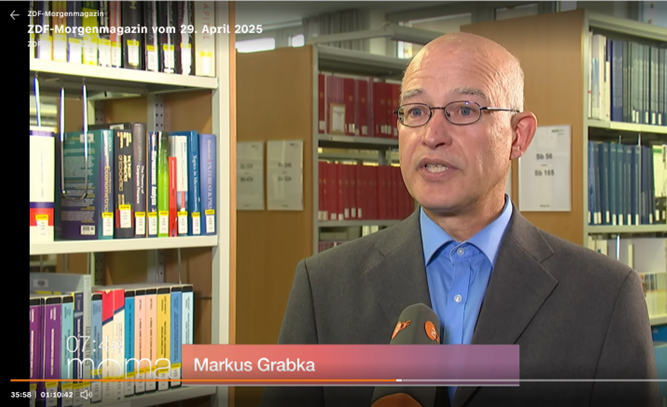
- Sabine Zinn in the Tagesschau (03.03.2025, 5p.m.), topic: Presentation of the current report on the living situation of Ukrainian refugees in Germany.

The #ManyDaughters Study is Officially Kicking Off!
We are pleased to announce the launch of the international research initiative #ManyDaughters led by Levent Neyse and Lab2 Team: The study examines how having daughters influence behavior, preferences, and attitudes – in other words, how they shape society.
Researchers from all fields of social sciences are invited to participate in this collaborative project, which use SOEP data to test four key hypotheses on the impact of daughters across various outcomes.
For more details, please visit the official study website: www.manydaughters.com and www.labsquare.net.
For further information please contact Levent Neyse.
SOEP Survey Committee Meeting
The regular meeting of the SOEP Survey Committee took place at the beginning of June – it was a productive exchange for us with very valuable scientific recommendations from the council. We thank all the members for their time and commitment!
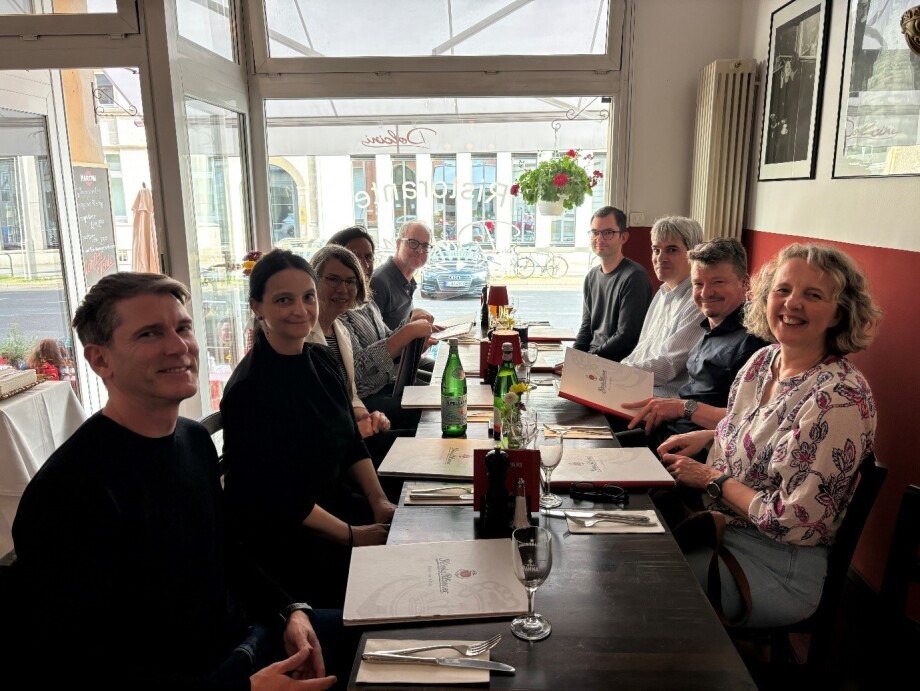
Dinner at the SOEP Survey Committee Meeting in June 2025, from left to right: Christian Hunkler, Sabine Zinn, Caezilia Loibl, Carsten Schröder, Joachim Winter, Philipp Lersch, Tobias Schmidt, Philippe van Kerm, Annette Scherpenzeel.
© DIW Berlin
Events
SOEP @ Lange Nacht der Wissenschaften
This year, SOEP/DIW Berlin is once again taking part in the Lange Nacht der Wissenschaften (Long Night of Science) under the umbrella of the Leibniz Association. Together with other Leibniz Institutes, a varied and exciting program is on offer. The evening’s program can be found on the Lange Nacht der Wissenschaften website.
WHEN: June 28, 2025, at 17.00 - 23.59 o'clock
WHERE: House of the Leibniz Association, Chausseestraße 111, 10115 Berlin
DIW Berlin will be represented with an information stand and three presentations, including one from the SOEP:
Jürgen Schupp (at 7 p.m. in Room Leipzig): Empirical results of the three-year field experiment “Basic Income Pilot Project”.
Further information on DIW’s presentations is found here (only in German). We look forward to welcoming many guests to the Leibniz Association’s HQ.
SOEP @ 11th ESRA Conference 2025 in Utrecht, Netherlands
The 11th Conference of the European Survey Research Association (ESRA) will take place from July 14 to 18, 2025, in Utrecht, The Netherlands.
The conference theme is "Promises and problems of new and alternative data sources and data formats for survey research. Methodological challenges and substantive conclusions."
21 SOEP researchers will organize 13 sessions and/or present their work across more than 10 presentations. An overview of the SOEP participations is found here (PDF, 516.21 KB).
SOEP will also have its own exhibition stand – so please stop by and learn more about SOEP data and our newest publications!
SOEP @ VfS Annual Conference 2025
The VfS Annual Conference 2025 will take place in Köln from September 14 to 17 under the heading “Revival of Industrial Policy.” This year's conference is dedicated to the comeback of industrial policy from the scientific and political perspectives. More information on the program you can read on the VfS website.
SOEP will also have its own exhibition stand and additionally will be represented by Levent Neyse. He is a member of the VfS Open Science Spotlight and co-organizer of the Open Science Workshop with Lars Vilhuber (Cornell University).
In addition, the VfS panel on open science will take place at DIW Berlin on September 15. For more information contact Levent Neyse.
SOEP @ 42nd Congress of the German Sociological Association
The 42nd Congress of the German Sociological Association will take place in Duisburg at the University of Duisburg-Essen (Duisburg campus) from September 22 to 26, 2025.
“Transitions” is the guiding concept for this congress, primarily intended to focus on the processes and dynamics of social, institutional, and individual changes in their various qualities. Thus, the focus is on the processes of transition with their moments of in-between, contingency, and openness alongside the possible regularity, regulation, and directionality of further developments within concepts of social change.
Together with Marc Hannappel (Koblenz), Knut Petzold (Zittau/ Görlitz), and Hawal Shamon (Jülich), Sabine Zinn is organizing a session within the “Modelling and Simulation” section entitled “Analytical Perspectives on Transition Processes: Patterns and Mechanisms Organization.”
Together with Felix von Heusinger, she will also give the presentation “The Simulation of Intergenerational Transfers of Home Ownership.”
There will also be a SOEP information stand on site.
SOEP @ Workshop on “Processes of Cumulative (Dis)Advantage in the Study of Inequalities: Theories, Conceptual Models, and Analytical Methods”
The workshop “Processes of Cumulative (Dis)Advantage in the Study of Inequalities: Theories, Conceptual Models, and Analytical Methods” will be held in Mannheim, Germany, from September 30 to October 1, 2025.
Philipp Lersch will give a talk on cross-domain cumulative advantages combining wealth and health trajectories.
Leibniz Open Science Day 2025: Better Science for Better Policies
Leibniz Open Science Day 2025: Better Science for Better Policies is organized by ZBW, RWI, DIW Berlin, WZB, and with the support of Lab.2 The workshop will take place at Leibniz Association's headquarters in Berlin on October 27.
It particularly invites submissions on the reliability, credibility, and generalizability of empirical work at the science-policy interface, but contributions on all meta-scientific topics in the social sciences are welcome, including, among others:
- Replications and robustness reproductions testing the internal or external validity of published work;
- Quantitative meta-analyses;
- Heterogeneity studies (e.g., Population, Design, Analysis);
- Role of normative views in empirical work; and
- Policy priorities.
For more information and to submit your work, please visit the workshop website and feel free to reach out to co-organizer Levent Neyse.
Report: Successful SOEPcampus online workshop series in June 2025
In June 2025, our online seminar series “SOEPcampus: Learn to Use the SOEP Over Lunch” successfully returned with new workshop leader Cristóbal Moya and more than 70 participants.
The workshop offered a comprehensive, practical introduction to the data of the German Socio-Economic Panel (SOEP). Participants learned about the content of the study, the data structure, sample selection strategy, weighting strategy, and were given an overview of the study documentation.
Further workshops are planned both in person and online for fall 2025. For more information, please visit our website or sign up for our mailing list.
SOEP Visiting Young Scholar Program (VYSP) – our guest program for early-career researchers
The SOEP has a special guest program for early-career researchers, the SOEP Visiting Young Scholar Program (VYSP). Program guests may be eligible for a reimbursement of their travel and accommodation expenses in case their stay lasts up to three months. Researchers younger than 35 who are planning/working on research projects involving SOEP data are invited to apply.
Applicants to the SOEP Visiting Young Scholar Program should submit a CV and a brief description of the research project (three pages maximum). The application should state the planned time frame and the SOEP dataset that will be used in the project. Researchers who take part in this program are expected to publish their findings as a SOEPpaper following their research stay.
Applications may be submitted at any time. Please keep in mind that we need some months to process your application.
For an application, please contact Janina Britzke. For further information see here.
People and Papers keyboard_arrow_up
Publications
SOEP Annual Report 2024: people, projects, and publications
In 2024, SOEP celebrated its 40th birthday with numerous high-profile guests, colleagues, and supporters. But that's not all: with 49 ongoing third-party funded projects, SOEP received a total of 11 million euros in outside funding. The important research focus “Social inequalities and distribution” was further strengthened: the new research group “Life Course and Inequality,” headed by Philipp Lersch, started with two high-caliber projects. At the same time, a project on inheritance and inequality (DE) funded by the Fritz Thyssen Foundation was launched.
Even 40 years after its launch, SOEP remains dynamic: in 2024, two new samples went into the field and an experiment tested people’s attitudes toward their carbon footprint.
SOEP researchers contributed numerous articles to the “Social Report 2024,” which, together with other experts in social research and official statistics, precisely analyzes living conditions in Germany. Thus, the report makes an indispensable contribution to comprehensive, reliable, and quickly accessible social reporting for Germany. The articles by the SOEP authors cover topics such as migration, mental health, and income equality.
The annual report for 2024 is now available in print upon request and for pdf download (PDF, 6.75 MB).
Two new publications about linking administrative and SOEP data
SOEP offers two data products in which the survey data is linked with administrative records from social insurance (unemployment insurance and pension insurance). In both administrative datasets, social-security earnings are censored at the contribution assessment ceiling. If you are interested in tail imputations of censored data, you may find our latest paper, which is based on the linked data, interesting:
"Dealing with censored earnings in register data".
This work complements a recent Stata Journal article introducing the easy to use beyondpareto.ado command:
"The beyondpareto command for optimal extreme-value index estimation".
- Beckmannshagen, M., König, J., Retter, I., Schluter, C., Schröder, C. & Tchokni, Y. (2025). Dealing with Censored Earnings in Register Data. Jahrbücher für Nationalökonomie und Statistik, 2025. DOI: 10.1515/jbnst-2024-0037.
- König, J., Schluter, C., Schröder, C., Retter, I., & Beckmannshagen, M. (2025). The beyondpareto command for optimal extreme-value index estimation. The Stata Journal, 25(1), 169-188. DOI: 10.1177/1536867X251322969.
A new survey module in SOEP Core 2025 on attitudes towards artificial intelligence
Artificial intelligence (AI) is changing our everyday lives – whether at work, in medicine, or in education. But what do people actually think about AI? To better understand this, a new survey instrument was developed: the ATTARI-WHE scale.
This short module, with just nine questions, records how people in Germany rate AI in the areas of work, health, and education - in other words, precisely where AI is used most frequently. There are three questions for each of these three areas of life.
The new scale was tested on over 1,000 people and shows very good results: Most participants answered all questions completely and without any noticeable bias. The instrument also worked reliably - regardless of gender, age, level of education, or employment situation.
The ATTARI-WHE scale is being used for the first time in the SOEP Core 2025. Thanks to its brevity, it is particularly suitable for larger surveys, online studies, and long-term surveys.
The new module is intended to provide a better understanding of how people think about AI - and what it takes for them to trust it.
Gnambs, T., Stein, J. P., Appel, M., Griese, F., & Zinn, S. (2025). An economical measure of attitudes towards artificial intelligence in work, healthcare, and education (ATTARI-WHE). Computers in Human Behavior: Artificial Humans, 3, 100106. DOI: 10.1016/j.chbah.2024.100106.
Basic income pilot project: no withdrawal from the labor market, but better mental health
"The results, particularly with regard to labor market behavior, can objectify some clichés such as that of the social hammock. Even if the unconditional basic income is not currently on the political agenda, all reform options will have to be considered for the urgently needed restructuring of the social systems - including the unconditional basic income," as Jürgen Schupp noted.
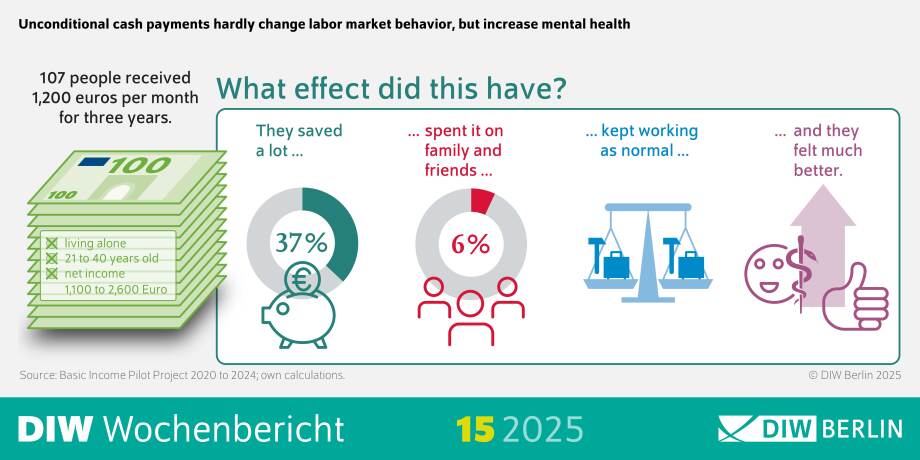
In June 2021, a large-scale field experiment on an unconditional basic income was launched in Germany. Two studies, summarized in this weekly report, led by Jürgen Schupp and co-authored by Sandra Bohmann (formerly at SOEP), investigate how unconditional cash transfers of 1,200 euros per month over a period of three years affected spending and labor market behavior as well as various indicators of mental health and subjective well-being. The 107 participants saved around a third of the cash payments, more than twice as much as the comparison group of 1580 people. They spent just under eight percent of the cash payments on charitable causes or to support family and friend networks. The participants neither withdrew from the labor market nor did they significantly reduce the hours they worked.
However, the payments led to a significant improvement in mental health and an increase in general life satisfaction as well as other indicators of well-being. The results, presented in DIW-Wochenbericht 15/2025 (only in German) (PDF, 428.84 KB), provide an evidence-based building block for objectifying the socio-politically relevant debate on unconditional cash payments.
The rbb accompanied the project, the 6-part documentary series “The big dream: money for all” is available in the ARD media library.
© DIW Berlin
Infographic for Bohmann, S., Susann Fiedler, Max Kasy, Jürgen Schupp und Frederik Schwerter (2025): Pilotprojekt Grundeinkommen: kein Rückzug vom Arbeitsmarkt, aber bessere mentale Gesundheit. DIW- Wochenbericht 15/2025, 221-229. (Audio-)Interview with Sandra Bohmann (DIW) (only in German).
School skills in Germany are more strongly influenced by social background than in other countries
The language and math skills of children starting school in Germany are more strongly influenced by social background than in other countries. This is the conclusion reached by study authors Jascha Dräger and Thorsten Schneider (Leipzig University) in DIW-Wochenbericht 14/2025 (only in German) (PDF, 350.32 KB). For their analysis, they evaluated and compared representative data sets from Germany, France, the United Kingdom, the Netherlands (using the city of Rotterdam as an example), the USA, and Japan. The results show that nowhere is there a stronger correlation between language skills and family background than in Germany. Only in the USA are math skills as unequal as in Germany. “Children from families with low incomes and lower parental education start school in Germany with greater educational disadvantages than in many other countries,” says Jascha Dräger. “One of the reasons for this is that early childhood education is not available free of charge across the board in this country.” In France, for example, where the influence of social background is significantly lower, there is a comprehensive and well-developed system of free early childhood care.

Infographic for Dräger, J. and T. Schneider (2025): Sprach- und Mathekompetenzen hängen in Deutschland bei Schulstart stärker von sozialer Herkunft ab als in anderen Ländern. DIW- Wochenbericht 14/2025, 209-215. Video-Interview with Jascha Dräger (DIW) on Youtube (only in German). (Audio-)Interview with Jascha Dräger (DIW) (only in German).
Staff News keyboard_arrow_up
Appointments
Levent Neyse was appointed as long-term visiting fellow at the London School of Economics and Political Science, Department of Psychological and Behavioural Science.
Awards
GOR Best Thesis Award 2025 for Julia Witton
Julia Witton received the Best Thesis Award 2025 from the German Society for Online Research (DGOF) at the General Online Research Conference (GOR 25) in early April for the presentation of her master's thesis, “Satisficing in a German Self-Administered Probability-Based Panel Survey,” which she wrote at SOEP. The prize is endowed with €500. Congratulations on this outstanding award!

Julia Witton gets the GOR 25 Thesis Award at the 27th General Online Research Conference
© DIW Berlin
Welcome to SOEP
Juliane Zenker joined the SOEP-LEE2 project as a research assistant in the division of applied panel analyses on April 1, 2025.
Appendix: Ankündigungen von externen Veranstaltungen und Call for Proposals keyboard_arrow_up
ECPD: Invitation: Freedom of Science, Diversity, and Public Health — 3 July at the Hertie School
We are pleased to invite you to an important public event on the future of open and inclusive research: Freedom of Science, Diversity, and Public Health – on Thursday, 3 July 2025, at Hertie School, Friedrichstraße 180, 10117 Berlin. Click here to register. For more information click here.
Organized by the Einstein Center Population Diversity (ECPD) and the Hertie School, this event will address the growing pressures on scientific freedom as democratic values decline and research funding becomes more constrained. In particular, it will explore how restrictions on academic inquiry – especially in the fields of public health, gender, and diversity – affect society at large, and why safeguarding open, inclusive, and well-supported research environments is critical.
The event will take the form of a moderated podium discussion, with ample time for audience engagement and informal exchange with everybody interested in the intersection of science, diversity, and public health.
GESIS Summer School in Survey Methodology 2025
The GESIS Summer School 2025 will take place from 23 July to 15 August 2025 – some courses will be held onsite in Cologne and some online.
Join lecturers and participants from all over the world and from many different fields in meeting in person and online to take part in Europe’s leading summer school in survey methodology, research design, and data collection. There is no registration deadline, but places are limited and allocated on a first-come, first-served basis.
Go to www.gesis.org/summerschool for an overview of this year’s.
There is no registration deadline, but places are limited and allocated on a first-come, first-served basis. You will find the full program, detailed course descriptions, and more information here.