DIW Economic Outlook Spring 2026
German economy on the upswing—global economy continues to grow moderately
- German economy on recovery path after three years of subdued activity – pressures from Iran war and erratic U.S. trade policy only slightly slow growth
- The recovery continues to be driven by the domestic economy, while export-oriented industry is
only gradually gaining momentum due to structural weaknesses and global uncertainty - Public investment is gradually picking up, initially in defense and later also in infrastructure – the
labor market remains robust - DIW Berlin forecasts German economic growth of 1.0 percent this year and 1.4 percent next year –
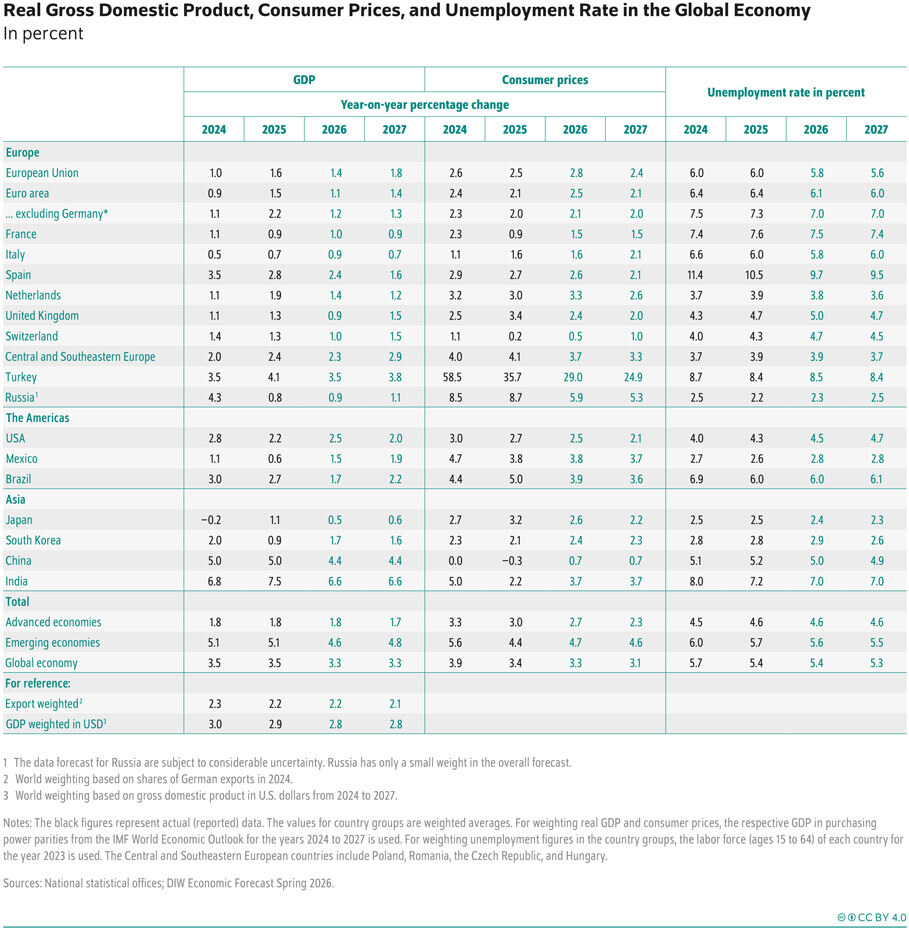
slightly below previous winter expectations - The global economy is expected to continue expanding moderately, with growth of 3.3 percent in
both 2026 and 2027
German Economy
German economy: Energy price hikes due to the Iran war only slightly dampen recovery
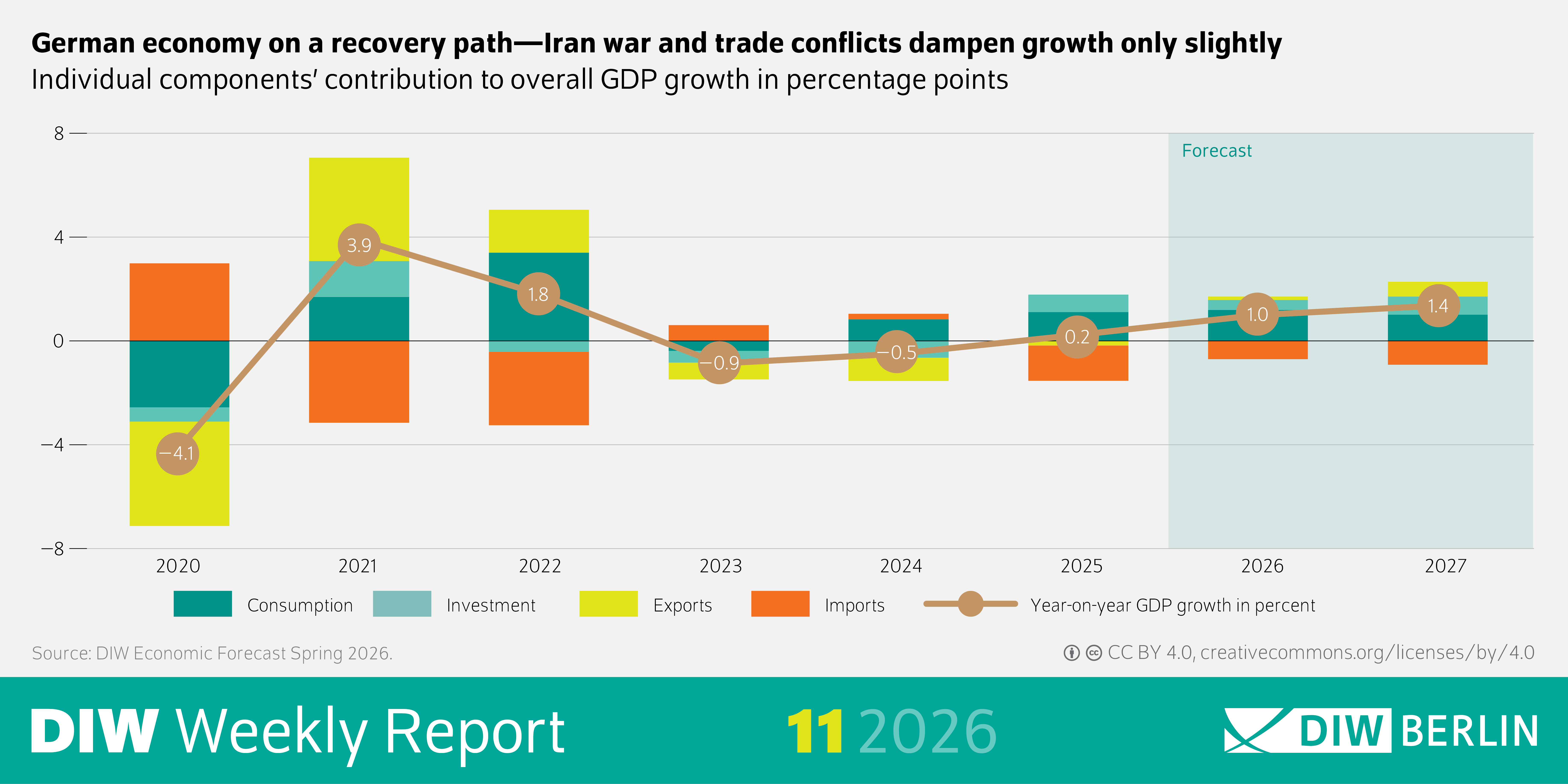
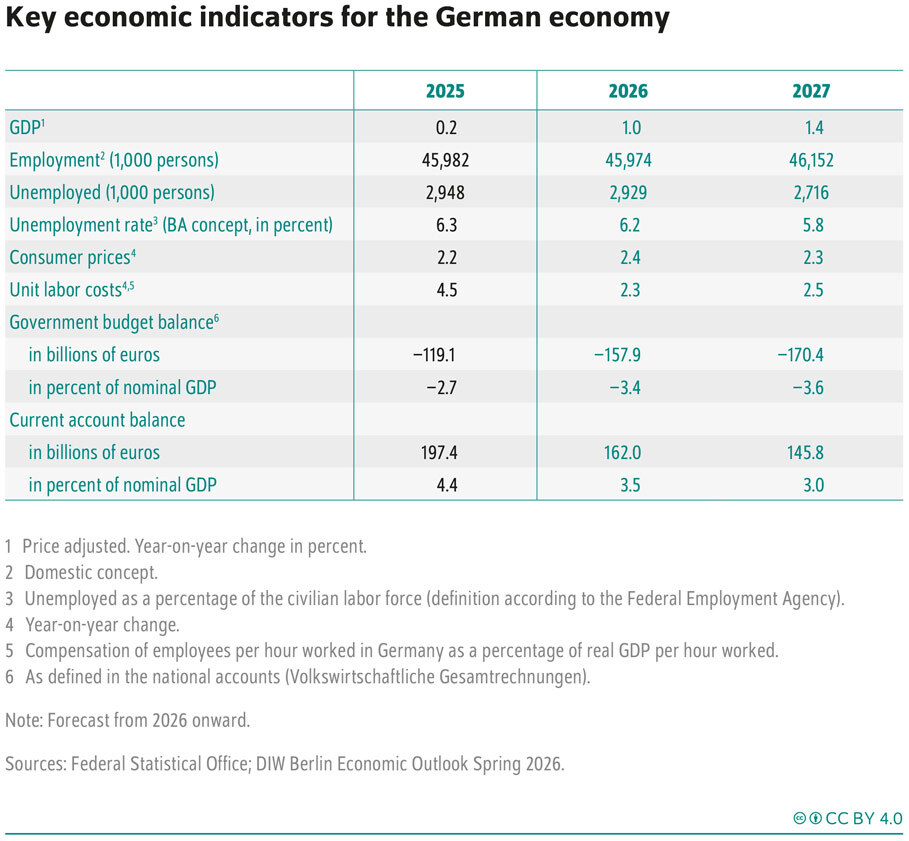
The German economy grew by 0.2 percent in 2025, driven primarily by strong private and public consumption. By the end of the year, economic activity had picked up noticeably. The upswing continued into early 2026, albeit at a slower pace. Nevertheless, it is likely to continue to strengthen, primarily due to highly expansionary fiscal policy: public consumption remains strong, and government investment is gradually picking up—initially in defense, and later in infrastructure. Private consumption continues to benefit from the robust labor market, while foreign trade remains weak due to declining competitiveness and global uncertainty. Higher energy prices are temporarily slowing growth slightly.
DIW Berlin expects growth of 1.0 percent for 2026 and 1.4 percent for 2027. The inflation rate is expected to be 2.4 percent in 2026 and 2.3 percent in 2027; further interest rate hikes by the European Central Bank are not foreseeable. The swift deployment of public funds remains crucial. The risks cut both ways: Faster project implementation could boost growth, while delays and capacity bottlenecks would slow it down. In terms of foreign trade, U.S. tariffs and geopolitical tensions remain key sources of uncertainty, while a de-escalation in the Middle East could bring relief in the form of falling energy prices.
“Oil and gas prices are likely to remain at a higher level in the coming months because of the Iran war, but will then gradually fall again. Inflation is expected to be about 0.4 percentage points higher, and economic growth is likely to be dampened by 0.1 to 0.2 percentage points. Overall, however, the recovery will not be halted by the Iran war.” Geraldine Dany-Knedlik
Golbal Economy
Between U.S. tariffs and the Iran war: The global economy remains resilient
The global economy is expected to continue expanding moderately over the forecast period, growing by around 3.3 percent this year and next. While slightly expansionary fiscal policies in many countries are supporting demand, protectionist U.S. trade policies and the war in Iran are dampening growth momentum, particularly starting in the second quarter of 2026. Regions with a high dependence on energy imports are particularly affected.