DIW Economic Outlook Winter 2025
German economy in the starting blocks—global economy holds its own
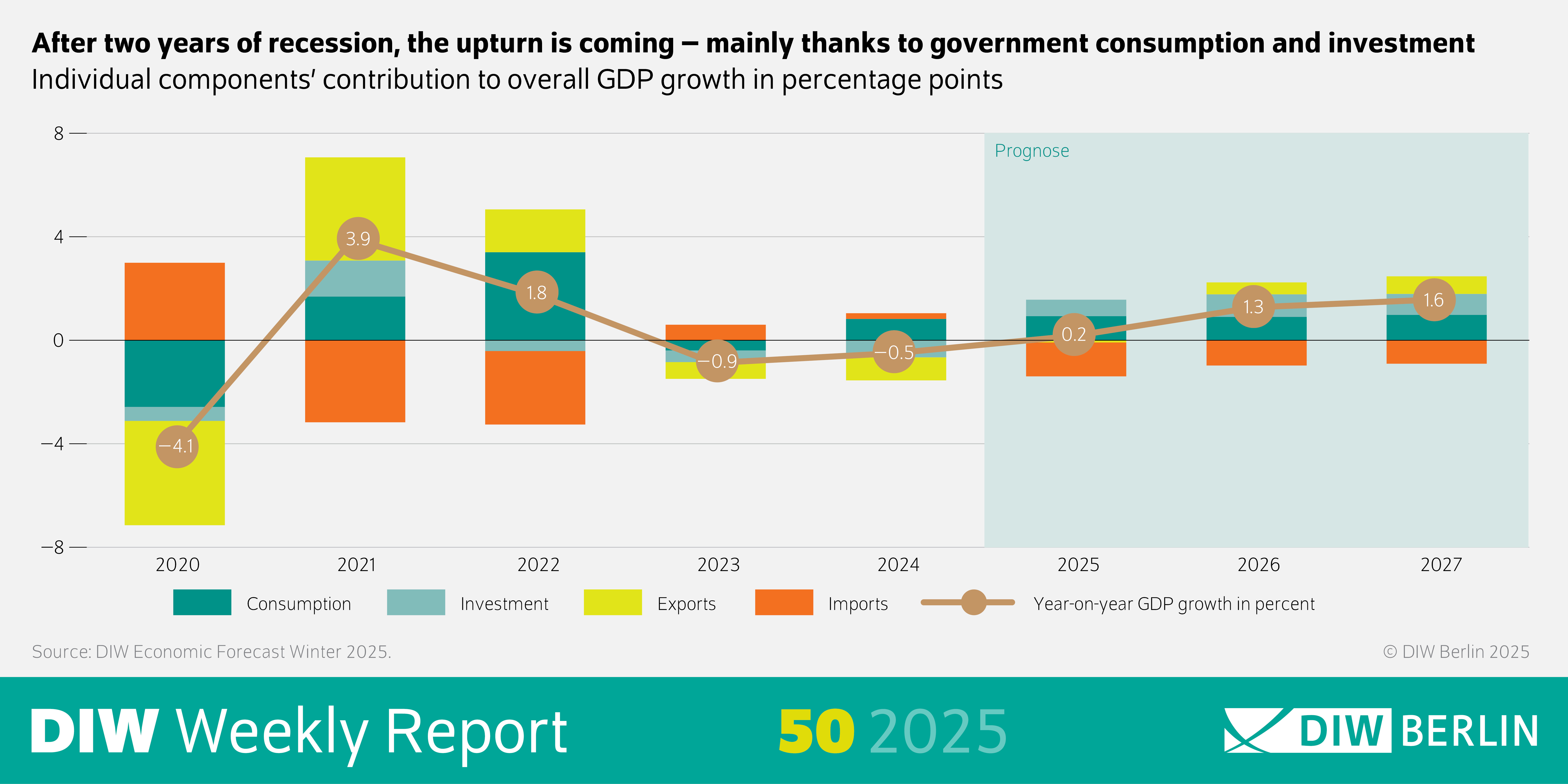
- The German economy has stabilized in the current year and is looking ahead to a fiscal policysupported upturn starting next year
- High public investment and strong government consumption are key factors—structural problems of the German economy likely to remain unresolved for the time being
- After an increase of 0.2 percent this year, DIW Berlin expects growth of 1.3 percent in 2026 and 1.6 percent in 2027
- Despite tougher US trade policy, the global economy is proving more robust than expected— higher tariffs are slowing growth, but global trade remains dynamic
- Forecast predicts global economic output to grow by 3.3 percent this year, 3.0 percent next year, and 3.2 percent in 2027
© DIW Berlin
German Economy
Upturn thanks to fiscal policy, structural weaknesses remain
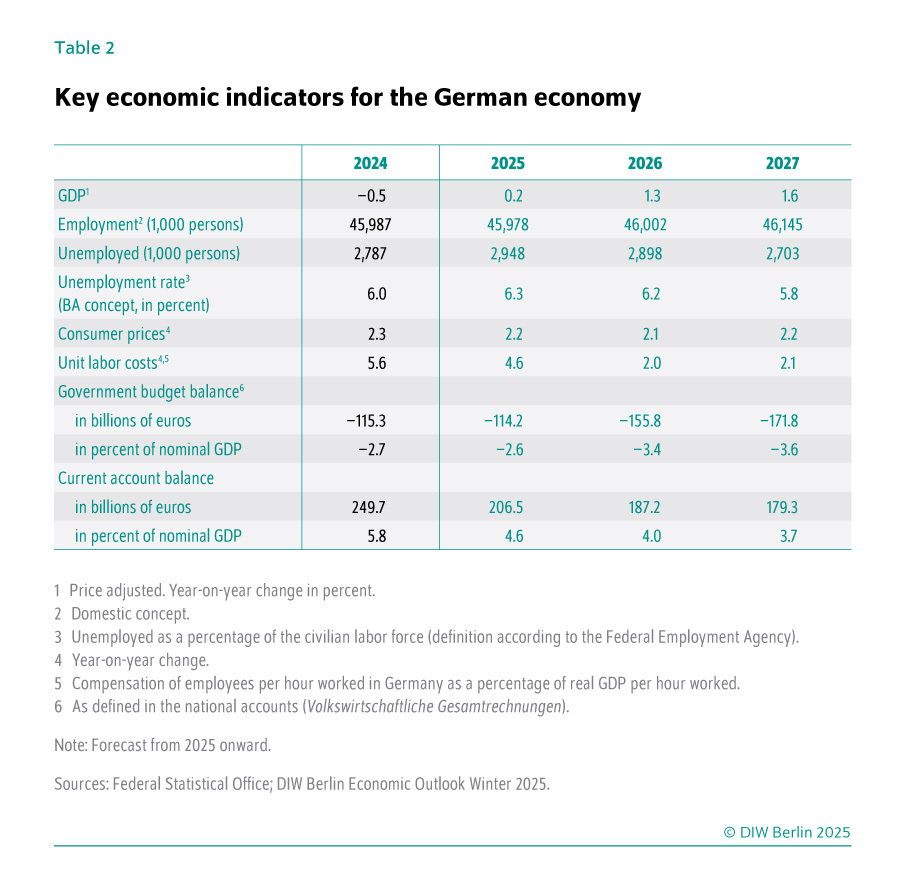
The German economy has stabilized in the current year and is looking forward to a fiscal policy-supported upturn starting next year. After an expected 0.2 percent in the current year, the DIW Berlin expects economic growth of 1.3 and 1.6 percent respectively for the next two years (key data table). It is crucial for the upturn that the additional public funds are actually used.
Since the fall, an expansion in public demand in particular has been providing important economic impetus. The private sector, on the other hand, has been more subdued so far. Global trade policy uncertainties, high production costs, and structural weaknesses are causing particular concern for the German export industry. Overall, the mood is not particularly cheerful at present – especially as the initial confidence that the new federal government would quickly improve the long-term growth outlook gave way to increasing disillusionment in the autumn months.
Local economic output stagnated in the third quarter. While private households and companies acted cautiously, a sharp rise in government spending prevented a further decline in economic output. Private consumption fell despite rising disposable incomes, and the savings rate rose to 10.7 percent. The tense situation on the labor market is likely to have been another factor. At the end of the year, it will again be the government that supports the economy, while private demand and investment activity will remain subdued. No impetus is expected from foreign trade in the short term. Overall, economic output is likely to grow by 0.2 percent in the fourth quarter.
A dynamic upturn is on the horizon for next year, although many structural problems are likely to remain unresolved for the time being. The expansionary stance of fiscal policy is decisive. The available fiscal leeway allows for rising public investment and strong government consumption. Increasing domestic demand is likely to stimulate investment in equipment and construction activity, while production, employment, and private consumption will gradually recover.
Key economic indicators for the German economy
© DIW Berlin
“The German economy is facing a rather atypical upturn, as upturns in this country are usually driven by high exports, a strong manufacturing sector, and corresponding investments in equipment. This time, however, it is primarily the sharp increase in public demand that is boosting the economy.” Geraldine Dany-Knedlik
Global Economy
Global economy proves more resilient to U.S. trade policy than expected
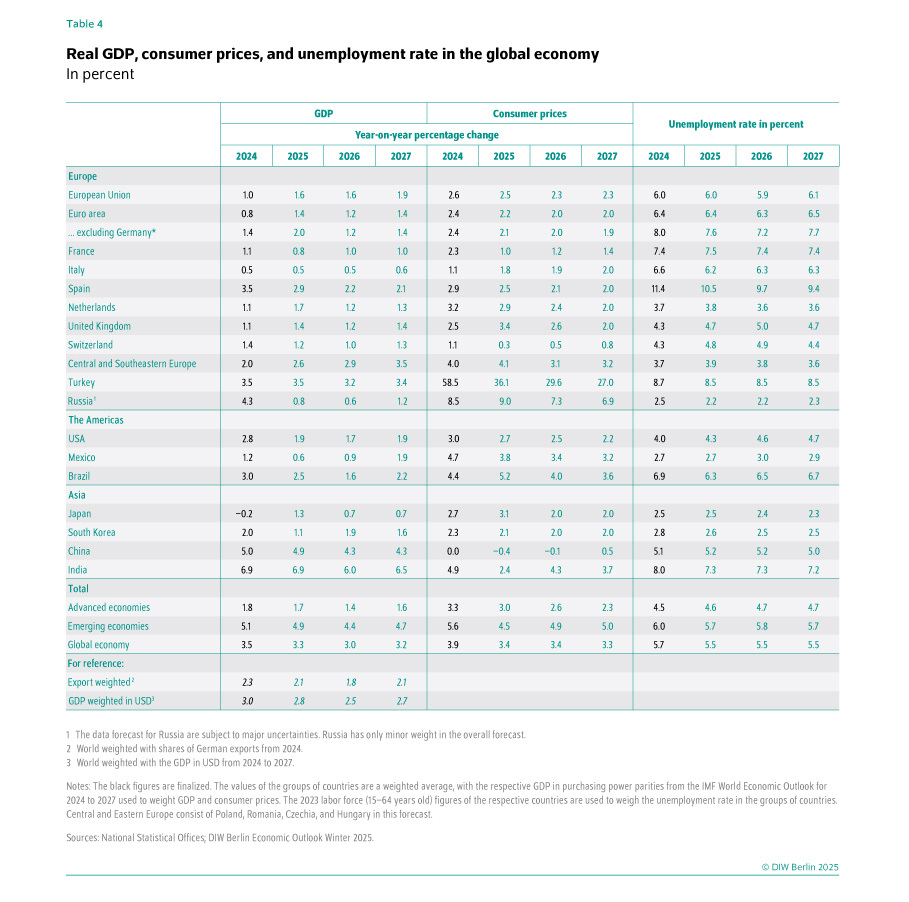
Despite the US tightening its trade policy, the global economy is proving more robust than expected. Higher tariffs are slowing growth, but global trade remains dynamic, particularly in Asia. New US agreements with numerous countries are reducing uncertainty and improving business sentiment in many places, while fiscal policy measures are supporting domestic markets. The US economy is losing momentum at the end of the year, the eurozone is growing moderately, and China is just missing its target. Global economic growth is expected to be 3.3 percent this year, 3.0 percent in 2026, and 3.2 percent in 2027 (table: real gross domestic product, consumer prices, and unemployment rate in the global economy).
Real GDP, consumer prices, and unemployment rate in the global economy
In percent
© DIW Berlin