SOEPnewsletter July 2026
Dear SOEP Community,
In early July, the German Science and Humanities Council (Wissenschaftsrat) announced its evaluation of the SOEP expansion proposal, rating it as “excellent” in all categories. We are delighted about this outstanding achievement. We are now eagerly awaiting the decision of the Joint Science Conference (Gemeinsame Wissenschaftskonferenz, GWK), which will determine the funding of the proposal this autumn.
In this issue of the SOEPnewsletter, you will find information on the latest data releases (see “Data Service”) as well as upcoming and recent events (see “News and Events”).
As always, we present a selection of interesting new publications based on SOEP data (see “Publications”) and share updates on SOEP staff and community members (see “Staff and Community News”).
We hope you enjoy reading!
Best regards,
Your SOEP Knowledge Transfer Team
Data Service keyboard_arrow_up

Updated versions of the SOEP-RV VSKT2022 and SOEP-RV RTBN2023 datasets available
New mighist variable “Migration History” available
BIOPAREN: Updated version of the dataset available
An issue affecting variables in the bioparen dataset has been identified and resolved. Users working with bioparen should update to the latest version of the dataset. Please contact soepmail@diw.de.
News and Events keyboard_arrow_up
News
Major Success for SOEP: German Science and Humanities Council Rates Expansion Proposal as Excellent
In its statement published on July 3, the German Science and Humanities Council (*Wissenschaftsrat*) rated SOEP as “excellent” in all three evaluation criteria: the scientific quality of the proposal, its national significance, and its structural relevance to the research system. “With its planned measures and innovations in data collection, data linkage, data provision, and data sharing, the SOEP expansion proposal opens up important new perspectives both for the institution itself and for the user community,” the statement notes. We are delighted by the Council’s assessment, which brings us a significant step closer to our vision of an even more modern and dynamic household survey. In autumn, the Joint Science Conference (*Gemeinsame Wissenschaftskonferenz*, GWK) will decide on the funding of the proposal.
READ THE ASSESSMENT (only in German)

Forum4Mica Expanded – Share Your Ideas: SOEP Feature Requests
Do you already know Forum4Mica? It is available for all your questions related to data and data generation. New: You can now also provide feedback on SOEP and discuss your ideas directly with other users. For example, you can share suggestions for future data collections, such as new variables, survey questions, or methodological developments, as well as proposals for e.g. new questionnaire items.

Geolinking Service SoRa: Successful Soft Launch
The Geolinking Service SoRa enables spatial analysis of social science survey data and contributes to socio-spatial research. It provides pre-prepared geospatial datasets as well as methods for linking survey and spatial data. On 13 May, a successful soft launch was held as an online event with 100 participants. To facilitate exchange among users of the SoRa geolinking service, a dedicated discussion thread is also available on Forum4Mica.

SOEP Receives the Kohli Foundation “Infrastructure Prize for Sociology”
In its award statement, the selection committee of the independent private Kohli Foundation highlighted SOEP’s role as a model and driving force in data infrastructure and sociological research—both within Germany and internationally.
Highlights from recent Events

International SOEP User Conference 2026
The 16th International SOEP User Conference (SOEP2026) was successfully held on July 8–9, at the Quadriga Campus in central Berlin, bringing together around 90 researchers from Germany and abroad. The conference provided an opportunity for researchers using SOEP data to present their work and discuss their findings with colleagues.

SOEPcampus@Santiago, May 2026
SOEPcampus@Santiago took place on 27–28 May at the Universidad Central de Chile in Santiago. The event was part of an initiative to strengthen SOEP’s international outreach and foster networking among researchers and graduate students in Latin America who are working on inequality, social stratification, and quantitative methods. Thanks to its high concentration of universities and research institutions, as well as growing interest in high-quality longitudinal data for social science research, Santiago proved to be an ideal venue. The participants were doctoral students, researchers, and lecturers. Further SOEPcampus workshops abroad are planned.
Upcoming Events
SOEPcampus@DIW Berlin (6–7 October 2026)
This two-day workshop on the Socio-Economic Panel (SOEP) at DIW Berlin includes presentations and hands-on sessions covering survey design, data structure, sampling design, and weighting strategies. It offers a practical introduction to the data and its research potential.
The workshop is suitable for researchers at all career stages who plan to work with SOEP data or are currently in the early stages of SOEP-based data analysis.
Registration has not yet opened. Please check the event page during summer 2026 (expected in August).

Workshop Call: Firms, Workers, and Households in Times of Crisis and Digital Transformation
As part of the SOEP-LEE2 project, AKempor (Working Group on Empirical Personnel and Organizational Research) will host a workshop at DIW Berlin on November 26–27 that focuses on research related to resilience, crisis response, digital transformation, and cybersecurity.
The workshop emphasizes empirical research using survey and linked data on firms, employees, and households. New data resources from the SOEP research infrastructure will also be presented. Submissions from economics, sociology, business administration, political science, and related disciplines are welcome until September 1, 2026.
People and Papers keyboard_arrow_up

Simply Explained: Pandemic Preparedness Using Health Data
In a brief overview published by the Leibniz Lab “Pandemic Preparedness,” you can learn how the SOEP uses health data to strengthen society’s resilience to future pandemics. The article also features videos in which Sabine Zinn discusses the topic.
READ THE FULL ARTICLE (only in German)

“Loneliness Affects Us as a Society as a Whole” – Statement by Theresa M. Entringer
Alongside this year’s action week “Gemeinsam aus der Einsamkeit,” a new Alliance Against Loneliness was launched with the participation of DIW Berlin. Theresa M. Entringer, a SOEP expert on loneliness, summarizes the importance of the topic in a brief statement.
READ THE STATEMENT (only in German)
Publications
Annual Report 2025 Published: Setting the Course for the Future of SOEP
As the recently published annual report demonstrates, the 42nd year of the Socio-Economic Panel marked an important turning point for the study. The report has been available for download (PDF, 6.99 MB) in English since June 1st.

Building Trust and Navigating Power Dynamics in Survey Research with Vulnerable Populations
Mariel McKone Leonard discusses ethical considerations in survey research with vulnerable populations as part of the Sage Research Methods: Inclusive Research Methodologies series. The video explores researcher positionality, power dynamics in the research process, and the challenge of balancing methodological rigor with participants’ lived experiences.
McKone Leonard, Mariel. 2026. Ethical Considerations for Survey Research with Vulnerable Populations. Sage Research Methods: Inclusive Research Methodologies. SAGE Publications. https://doi.org/10.4135/9781036255954
COVID-19 Has Little Influence on Risk Preferences
A new analysis by Daniel Graeber, Ulrich Schmidt, Carsten Schröder, and Johannes Seebauer, based on SOEP data and regional variation in infection rates, shows that individual risk preferences remain largely stable despite rising financial worries and anxiety. The findings suggest that a pandemic primarily changes the immediate decision-making environment rather than individuals’ underlying preferences.
Graeber, Daniel, Ulrich Schmidt, Carsten Schröder, and Johannes Seebauer. 2026. Navigating uncertainty: Do communicable diseases influence risk preferences? Journal of Risk and Uncertainty. https://doi.org/10.1007/s11166-026-09497-7
Study on the Replicability of Social Science Research
SOEP researcher Cristóbal Moya participated in a large international study on the replicability of social and behavioral science research that was published in the prestigious journal Nature. As part of the SCORE project, 274 findings from 164 scholarly articles were independently evaluated.
Approximately half of the findings could be replicated, although the measured effects were often smaller than those reported in the original studies. Replication rates varied across disciplines between roughly 43 and 63 percent. As also reported by The New York Times, the study further shows that both human experts and AI models can partly predict replication success. The findings underscore the importance of transparency, open data, and robust scientific evidence.
Tyner, Andrew H., Anna Lou Abatayo, Mason Daley, et al. 2026. Investigating the replicability of the social and behavioural sciences. Nature, 652, 143–150. https://doi.org/10.1038/s41586-025-10078-y
SOEP-IS Study Confirms the Knobe Effect
A study conducted within the SOEP Innovation Sample (SOEP-IS) by Christoph Schmidt-Petri, Daniel Labarca Pinto, and Carsten Schröder with 2,295 respondents confirms that people are much more likely to attribute intentionality to harmful side effects than to beneficial ones.
The findings replicate a classic result from experimental philosophy using representative population data and highlight the potential of SOEP-IS for innovative behavioral research.
Schmidt-Petri, Christoph, Daniel Labarca Pinto, and Carsten Schröder. 2026. Quantifying the Knobe effect: population-level patterns and heterogeneity analyses. Philosophical Psychology, 1–33. https://doi.org/10.1080/09515089.2026.2676274
Historical Changes in Control Beliefs
A recent SOEP study of more than 42,000 respondents by a research team led by Theresa M. Entringer shows that younger birth cohorts in Germany are more likely to believe that they can influence their lives and maintain this sense of control into older age. While differences between genders and income groups have narrowed, disparities between people in East and West Germany have widened. Major life events, such as unemployment or disability, are associated with greater declines in control beliefs than they were in the past.
Entringer, Theresa M., Laura Buchinger, Jutta Heckhausen, Nilam Ram, and Denis Gerstorf. 2026. Historical Changes in Control Belief Trajectories. European Journal of Personality (online first). https://doi.org/10.1177/08902070261454669
Record Levels of Sick Leave: Respiratory Illnesses and Behavioral Change Are the Main Drivers
According to a new study based on SOEP data, rising employee absenteeism cannot primarily be attributed to the introduction of electronic sick notes (eAU). Study author Markus M. Grabka concludes that partial sick leave arrangements and additional preventive measures could help counteract this trend.
READ THE DIW WEEKLY REPORT (PDF, 0.57 MB)
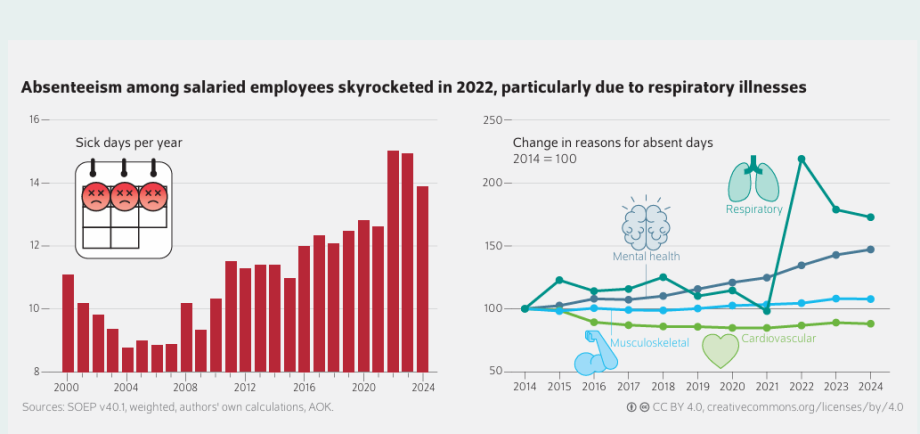
Infographic for Grabka, M. M., and Breer, O. (2026): The Rise in Absenteeism in 2022 Is Only Partly Due to Electronic Sick Notes. DIW Weekly Report 20+21/2026, 167–174. (Audio) interview with Markus M. Grabka (DIW) (only in German) (PDF, 141.41 KB).
Healthcare System Remains Difficult to Access for Refugees During the First Years After Arrival
A new SOEP study by Louise Biddle, Andrea Marchitto, and Elena Sommer based on the IAB-BAMF-SOEP Survey of Refugees identifies long waiting times, distance, costs, and a lack of orientation as the most significant barriers.
Lead author Louise Biddle warns that delayed access to healthcare may result in higher long-term costs for the healthcare system. Structural simplifications and improved health communication could help address these challenges.
READ THE DIW WOCHENBERICHT (only in German) (PDF, 379.66 KB)
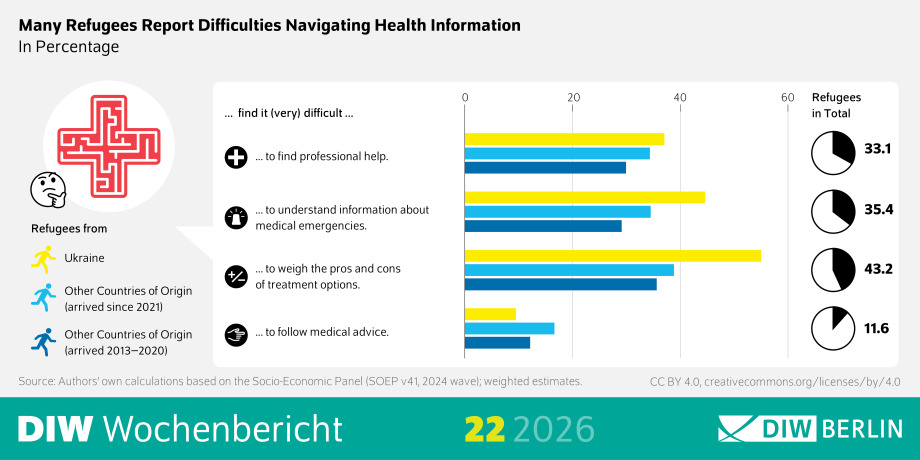
Infographic for Biddle, L., Marchitto, A., Sommer, E. (2026): Healthcare system remains difficult to access for refugees during the first years after arrival. DIW Weekly Report 22/2026, 331–337. (Audio) interview with Louise Biddle (DIW) (only in German) (PDF, 86.37 KB).
Staff News keyboard_arrow_up

Passing of Richard Hauser
Professor Dr. Richard Hauser passed away in early April at the age of 89. With his death, SOEP loses one of its founding fathers, a long-standing supporter, and a steadfast advocate.
Appointments
Effective July 1, 2026, Jan Goebel was appointed for a three-year term as a member of the 9th appointment period of the German Data Forum (RatSWD).
Changes to the SOEP Survey Council
The SOEP Survey Council welcomes Katrin Rehdanz (Christian-Albrechts-University of Kiel) as a new member. In addition, Caezilia Loibl (The Ohio State University), Oliver Lipps (FORS), and Tobias Schmidt (Deutsche Bundesbank) have been reappointed for another term. After two terms of service, Philippe Van Kerm (University of Luxembourg) has stepped down.
Successful Promotions

Former SOEP doctoral researcher Valeriia Heidemann successfully defended her dissertation, “The Long Shadow of Forced Migration: Parental Associations with Birth Outcomes and Early Childhood Development,” at Humboldt University (HU Berlin) on March 10th. Her supervisors were Sabine Zinn (HU Berlin, SOEP) and Anna Oksuzyan (Bielefeld University).

Lorenz Meister successfully defended his dissertation, “Essays on Economic Beliefs, Risk Preferences, and Political Attitudes in Contemporary Democracies,” at Freie Universität Berlin on June 18th. His supervisors were Carsten Schröder (FU Berlin, SOEP) and Panu Poutvaara (LMU Munich).
We congratulate both on their impressive achievements!
Further Awards
Christian Hunkler and Co-Authors Receive Award for Best DIW Wochenbericht
At its summer party on June 18, DIW Berlin honored the weekly report “Social Media: Public Supports Regulation – Majority Support for Age Restrictions Only up to Age Twelve (PDF, 453.42 KB)” as the best DIW Wochenbericht. The article is based on findings from the first SOEP Flash Survey and was authored by Jörg Dollmann, Christian Hunkler, Nicolas Legewie, Julian B. Axenfeld, Andreas Franken, and Felix von Heusinger.
Welcome to SOEP
Okan Sahin joined SOEP on April 13th in the Data Operation and Research Data Center team and serves as Software Manager for the replication platform.
Lisa Klein, previously a visiting researcher at SOEP, joined on June 1st as a research associate in the DECIPHE project and the “Life Course and Inequality” research group. Her research focuses on inequality, wealth, and poverty from a life-course perspective.
A warm welcome to both!
Community News keyboard_arrow_up
Funding Approved for Second Funding Period of the Leibniz Research Network “Resilient Ageing”
The Senate of the Leibniz Association has approved the continuation of the Leibniz Research Network Resilient Ageing for another four years under the leadership of Daniel Graeber and Johannes Geyer, funded through the Leibniz Competition procedure.
The network brings together 14 Leibniz institutes and is coordinated by the Leibniz Institute on Aging – Fritz Lipmann Institute in Jena and the Leibniz Institute for Resilience Research in Mainz. Its interdisciplinary research combines expertise from biology, environmental sciences, medicine, and social sciences.
Call for Papers: Leibniz Open Science Day 2026
On November 17, 2026, the third Leibniz Open Science Day will take place in Berlin under the title “Scientific Rigor and Collaborative Research in the Age of AI.” The event is jointly organized by ZBW – Leibniz Information Centre for Economics, DIW Berlin (Levent Neyse), WZB Berlin Social Science Center, RWI – Leibniz Institute for Economic Research, and Lab² – Metalab for Better Science. Submissions are invited on all aspects of meta-science and open science in the social sciences, with particular interest in research addressing the reproducibility, transparency, credibility, and generalizability of empirical findings. Contributions do not need to focus on AI.
Submission deadline: July 31, 2026
Appendix: External Events and CfPs keyboard_arrow_up
Call for Abstracts: PhD Workshop “Perspectives of (Un-)Employment”, January 2027
The IAB’s and FAU’s joint graduate programme GradAB is inviting young researchers to its 18th interdisciplinary PhD workshop “Perspectives on (Un-)Employment,” which will take place January 21-22, 2027, at the Institute for Employment Research in Nuremberg. This event brings together qualitative, quantitative and mixed-methods research from the disciplines of economics, sociology as well as statistics and data science. It provides an opportunity for junior researchers to present their ongoing work in the field of theoretical and empirical labor market research, and to receive feedback from leading scholars in the field. Our keynote speakers will be Anders Frederiksen, Frauke Kreuter and Mara Yerkes. The deadline for submission is August 31, 2026 (CEST). Find the full call for abstracts here.
OECD Youth Workshop in Berlin | October 5, 2026
On October 5, 2026, the OECD – with the support of the TUI Care Foundation – is hosting a workshop in Berlin, Germany, under the theme: Entrepreneurship and Education Systems: Shaping the Future Together. Get a seat at the table with OECD experts and Youthwise – the OECD's Youth Advisory Board – and help shape the OECD's work from the inside.
If you're between 18 and 30, this is your chance to connect with peers from across countries and backgrounds and build contacts within the OECD. You can sign up here, registration closes on September 1.