Employing refugees makes companies more productive and attractive
Press Release of May 18, 2022
Survey of 100 medium-sized and large companies in Germany examines the integration of refugees into the labor market – Employing refugees improves employee satisfaction, company attractiveness, and business development – Potential for self-employment remains largely untapped among refugees
Employing refugees has made them more attractive as employers. This is reported by 80 percent of the companies that took part in a survey on the integration of refugees in the summer of 2021. “Especially against the current backdrop of the many refugees from Ukraine, the experiences of companies are becoming increasingly relevant,” says Alexander Kritikos, member of the Executive Board at the German Institute for Economic Research (DIW Berlin), who conducted the study together with DIW Econ. The survey was conducted in the summer of 2021 on behalf of Tent Partnership for Refugees among 100 medium-sized and large companies in Germany that have hired a total of more than 4,000 refugees since 2015.
“The experiences with refugees who arrived in the country in 2015 provide valuable lessons for the future integration of Ukrainian refugees.” Alexander Kritikos
More than half of the companies say that hiring refugees has also increased the productivity and length of employment of their workforce. However, companies first had to overcome challenges associated with integrating refugees into the work environment, such as hurdles in the hiring process, lack of language skills, and unrecognized qualifications.
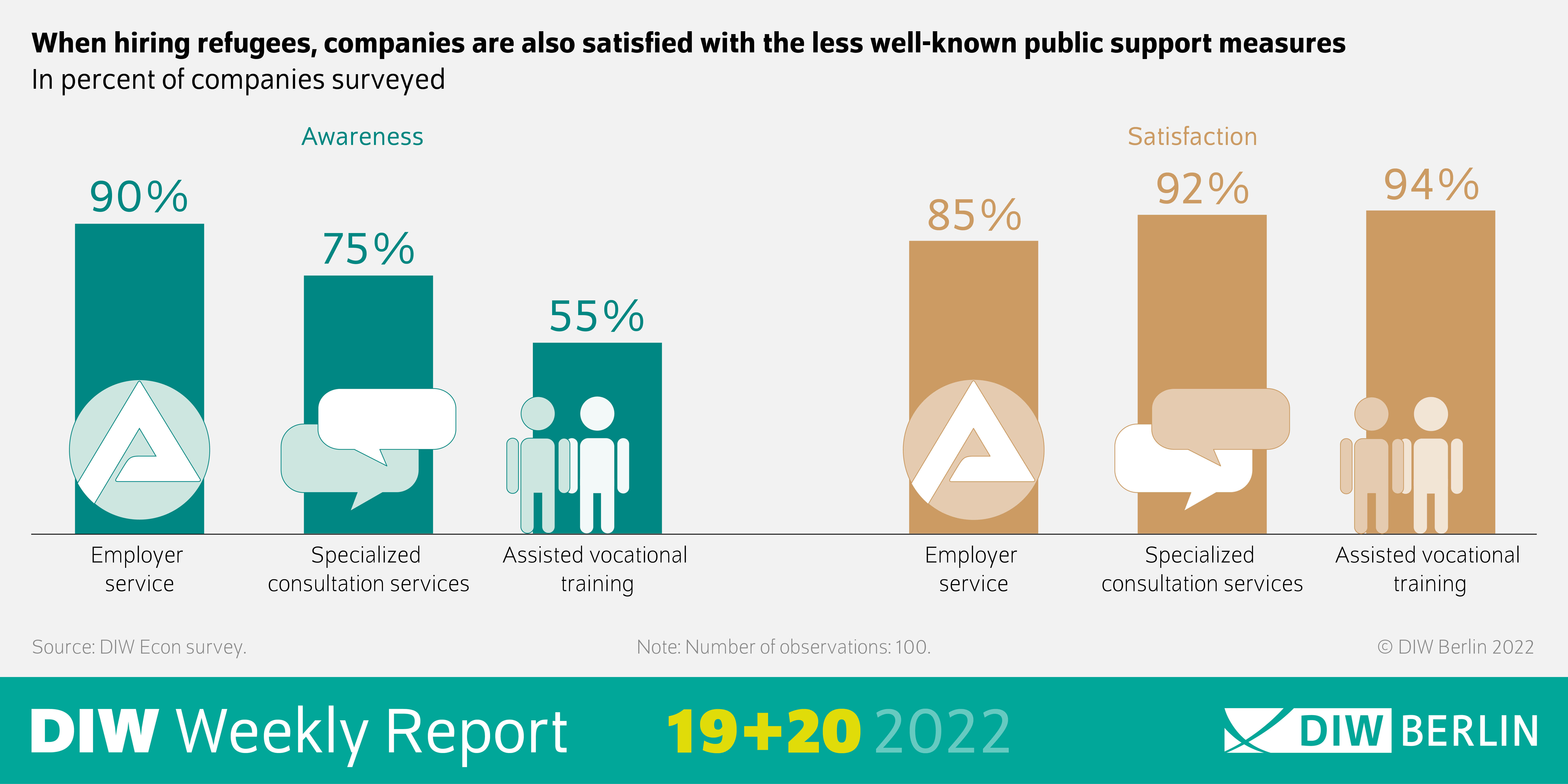
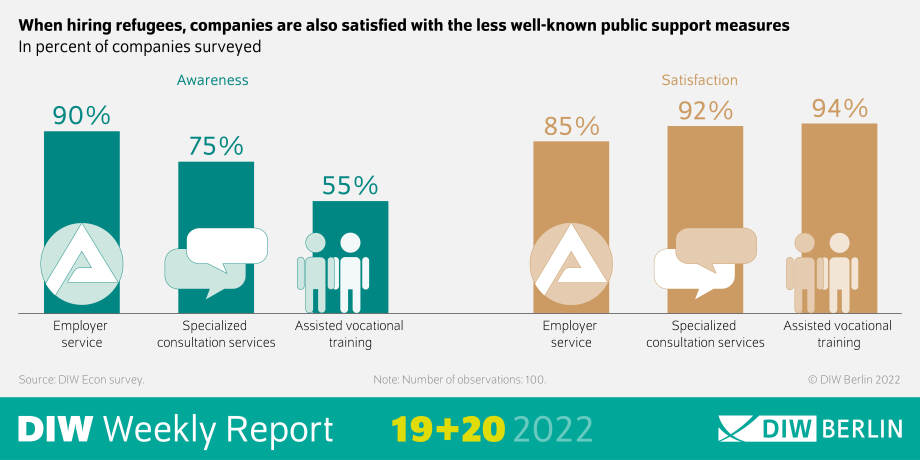
Companies primarily solve these problems by taking advantage of government and private support services. Or they take internal measures: around 75 percent of companies offer language courses, for example. In addition, trial work directly before signing a contract plays an important role in analyzing qualifications. The most widely used government support services are the employer services offered by employment agencies and job centers, which 90 percent of companies are familiar with, and the integration subsidy, which 83 percent are familiar with. Around 90 percent of companies that use these services are satisfied with them. Even lesser-known services such as assisted training achieve high satisfaction ratings.
© DIW Berlin
“Targeted public relations work on the positively rated support services and further development of the language courses on offer can help to encourage more companies to hire refugees in their businesses,” says study author Alexander Kritikos with conviction. This is because the employment of refugees has stagnated since the beginning of the pandemic. However, appropriate public relations work will also be crucial in the coming years if Ukrainian refugees are to be integrated into the labor market. “The experience gained with the refugees who came to the country in 2015 can be used to inform the future integration of Ukrainian refugees.”
While government and private measures have been successful in integrating refugees into dependent employment, the potential for self-employment remains largely untapped. Start-up activities among refugees are far less common in Germany than in their countries of origin. “In addition to targeted public relations work to promote the support services offered by companies, bureaucratic obstacles should be removed and greater attention should be paid to financial support measures that make it easier for refugees to start their own businesses,” recommends DIW economist Kritikos.
Topics: Firms , Labor and employment , Migration