SOEPnewsletter November 2025
Dear SOEP community,
You have probably already heard that Mohrenstraße has finally been renamed. Our new, old address is now: Anton-Wilhelm-Amo-Straße 58, 10117 Berlin.
In the current issue of the SOEPnewsletter 2025, you will find all the information you need about the latest data releases (see “Data Service”) as well as upcoming and past events (see “News and Events”).
As usual, we present a selection of interesting new publications based on SOEP data (see “Publications”) and provide news about our SOEP staff (see “Staff News”).
We hope you enjoy reading!
Your SOEP Knowledge Transfer Team
Data Service keyboard_arrow_up
New Dataset: SOEP-Core Data 1984-2023 (v40.1) available now
All registered data users can now access the latest data v40.1 (DOI: 10.5684/soep.core.v40.1eu) via our online order form.
In German: http://www.diw.de/SOEPbestellung
In English: http://www.diw.de/SOEPorder
Important news for v40.1:
- Contains the German part of the Cross-National Equivalent Files (CNEF) bnpequiv and the corresponding data for 2023 in the long-format file pequiv.
- Updated weighting factors using the marginal distributions for 2023 and updated marginal distributions for 2022 and 2021 based on the microcensus adjusted to the “2022 Census.”
- Updated specific variables: pgfamst (family status) in pgen and iyear and imonth (month and year of the survey) for the years 2021–2023.
Further details on data delivery can be found as a supplied "WhatsNew" document in the data package or here.
The 2024 wave of the establishment and self-employment survey from the SOEP-LEE2 project will be released alongside the SOEP-Core v41
The primary goal of the SOEP-LEE2 project is to link establishment-level information with individual-level data from the SOEP-Core. In cooperation with the Institute for Personnel and Work (IPA) at the Helmut Schmidt University/University of the Federal Armed Forces Hamburg (HSU) and funded by the German Armed Forces Center for Digitalization and Technology Research (DTEC.Bw) and the EU (NextGenerationEU), the SOEP-LEE2 project conducts surveys of establishments employing SOEP respondents who work as dependent employees or civil servants. Additionally, establishments that cannot be linked to the SOEP-Core and are drawn from the Federal Employment Agency's establishment database through a stratified random sample are also surveyed (SOEP-LEE2-Compare) with the same questionnaire as used for the establishments of SOEP-Core respondents. This comparison sample enables the quantification of potential selectivity biases and increases the case numbers for establishment-level analyses. Furthermore, SOEP-Core participants who are self-employed are surveyed about their entrepreneurial activities. These surveys were conducted in 2022 and 2024, with another survey scheduled for 2026.
Key topics include the digitalization of workplace, skilled labor shortages, organizational and human resource management challenges, investments and innovations, as well as sustainability and CO2 emissions.
Researchers who wish to work with the data can either order them as part of the SOEP-Core EU Edition (see SOEP data access) or access them on-site at the Research Data Center of the SOEP (see SOEP-in-Residence program). In the RDC SOEP, researchers have access to the onsite edition, which provides more detailed scales and categories for some variables in the SOEP-LEE2 dataset. The 2020 and 2022 waves of the self-employment survey and the 2022 establishment survey are already available. The 2024 wave of all surveys will be released together with SOEP-Core v41.
Documentation of the questionnaires, variables, and datasets can be found here and on paneldata.org. For questions or information about the project, datasets, or documentation, please contact Daniel Labarca Pinto.
SOEP-IS: Call for Submissions
The SOEP Innovation Sample (SOEP-IS) is designed to enable innovative data collection for the research community. It is particularly well suited to establishing new and target-group-specific measurement instruments in long-term surveys, to conducting short- and long-term experiments, and to collecting non-survey data (such as biomarkers).
Researchers who are interested in submitting a proposal for data collection in 2027 should keep the following deadlines in mind: The call for submissions is already open, and if you would like to submit a proposal, you should visit the SOEP-IS FAQ page and send a short submission form by January 16, 2026. The SOEP-IS Scientific Committee will review all proposals and notify researchers of the results by February 16, 2026. Researchers whose proposals receive conditional acceptance will then be invited to submit a complete submission package using the official template by April 30, 2026. Questionnaire design will usually start the following fall. Data will be collected starting in 2027. More information and the short submission form can be found here.
News and Events keyboard_arrow_up
News
Extraordinary evaluation of the SOEP
In July and September 2025, an extraordinary evaluation of the SOEP was conducted by a group of experts from the Leibniz Association and the German Council of Science and Humanities. This was because the SOEP had submitted a large strategic enhancement application (gSTB) to the Leibniz Association via the Berlin Senate Department for Science, Health, and Care. The aim is to make SOEP financially and substantively future-proof. From SOEP's perspective, both evaluations went well, but an official statement from both committees is not expected until next year. “The SOEP team has shown great teamwork. We would like to express our sincere thanks to all supporters for their commitment to the evaluation of the major special case,” summarizes Sabine Zinn, Director of SOEP.
Spotlight: SOEP research in the media
Topic: “Refugees in Germany”
It has now been ten years since former German Chancellor Angela Merkel expressed her conviction regarding the refugee policy pursued at the time: “Wir schaffen das” (We can do it) – and many media outlets are taking the anniversary of this landmark statement as an opportunity to take a critical look at the situation. “Ziemlich geschafft,” headlines DER SPIEGEL on July 31, 2025, using data from the IAB-BAMF-SOEP survey of refugees, which has been running since 2016 and was provided exclusively by SOEP for this issue.
The study also forms the basis for DIW-Wochenbericht 35/2025 (only in German) (PDF, 2.95 MB ) , published on August 27, 2025, which contains three articles on the topics of welcoming culture, naturalization, and early childhood development, as well as for a “DIW "Nachgeforscht" video (only in German) with Sabine Zinn.

© DIW Berlin
Other national media outlets have also publicized the SOEP's research findings:
- Handelsblatt: „Forscher rechnet mit mehr Einbürgerungsanträgen“, 27.08.2025
- DER SPIEGEL: „Rund 98 Prozent der Geflüchteten wollen sich einbürgern lassen“, 27.08.2025
- tagesschau.de: „Geflüchtete fühlen sich weniger willkommen“, 27.08.2025
- DIE WELT: „So viele Migranten streben in Deutschland die Einbürgerung an“, 27.08.2025
- ZDFheute, Zahl des Tages: „Geflüchtete fühlen sich in Deutschland immer weniger willkommen“, 28.08.2025
- Süddeutsche Zeitung: 10 Jahre "Wir schaffen das": Was wurde aus den Geflüchteten von damals?, 11.08.2025
Topic: “Loneliness in Germany”
Not least due to the German government's loneliness strategy, loneliness and its consequences for society are receiving increased public attention. The YouTube episode of the online research channel “Sollten wir darüber reden?!” (Should we talk about it?!) provides a good overview of the subject: “Einsamkeit – Bist Du gefährdet? Was Deine Persönlichkeit darüber verrät" (Loneliness – Are you at risk? What your personality reveals about it) for which SOEP researcher Theresa Entringer, among others, was interviewed as an expert.

The magazine GEO also addressed the topic on September 22, 2025, calling the SOEP the “most reliable source of data on loneliness in Germany”: „Was die Forschung über männliche Einsamkeit weiß (only in German)“ (What research knows about male loneliness”) (article for subscribers).
Topic: “SOEP in general”
„Wir wollen gesellschaftlichen Wandel verstehen (only in German)“ (We want to understand social change) – the SOEP is summarized concisely and vividly in this entertaining film with Sabine Zinn, which was produced as part of the “100 Years of DIW” series and has been viewed around 50,000 times on Instagram. It is one of the most-watched reels in the “100 Years of DIW” series marking the institute's 100th anniversary.

© DIW Berlin
Related podcast: „Ein Schatz, der immer weiter wächst“ (only in German) (A treasure that keeps growing).

© DIW Berlin
The “100 Years of DIW” series includes other interesting articles (only in German) from SOEP, e.g.:
- Mit langem Atem zur Versicherungspflicht (The long road to compulsory insurance) – and the research of Gert G. Wagner,
- Welche Wirkung hat ein bedingungsloses Grundeinkommen? (What is the effect of unconditional basic income?) – and the research of Jürgen Schupp,
- Psychische Gesundheit junger Menschen hat sich verschlechtert (The mental health of young people has deteriorated) – and the research of Daniel Graeber.
Digitization project “Historical DIW Wochenberichte”
DIW’s Weekly Reports (DIW-Wochenberichte) from 1969 to 2004, digitized as part of the DFG project “Weekly Report Digital in Words and Numbers – Digital Provision of DIW Weekly Report Content 1928 to 1968 (WBdigital)” and from the institute's own resources, are now available in digital form. The back-catalogue of Weekly Reports are available in PDF format on the website „Wochenberichte retrospektiv 1928 bis 2004.“ A catalog search is possible on this page, but not full-text search. It also includes articles based on SOEP data. We look forward to seeing this new digital resource being used by many people.
Upcoming Events
Working successfully with SOEP data: Register now for the next SOEPcampus event
SOEPcampus workshops are helpful for both SOEP beginners and advanced users: In addition to practical instructions on how to prepare the data, you can refine your SOEP knowledge and receive direct assistance in preparing your data set.
Our regular program consists of both online and in-person modules—the dates for the next event can be found here:
Learn to use the SOEP over lunch: Online workshop series in November and December
The workshops will take place on Wednesdays (November 26, December 3 and 10, 2025) during lunchtime. Participants will be introduced to the content of the study, the data structure, the sample selection, and the weighting strategy, and will receive an overview of the study documentation.
We use Microsoft Teams for the free online seminar.
Target group: Researchers at all qualification levels who want to work with SOEP data in the future or are currently in the early stages of SOEP-based data analysis.
Language: English
Registration: Please register by November 25, 2025, by sending an email to Janina Britzke with your name and institution. Invitations with the participation link and any materials will be sent out in the week before the first session in November. There is no limit to the number of participants.
International SOEP User Conference – Call for Papers
The call for papers for the 16th International German Socio-Economic Panel User Conference is online. SOEP 2026 will take place from July 8-9, 2026, in Berlin, and researchers from all disciplines are invited to submit an abstract. We particularly welcome contributions addressing meta-science, robustness, replicability, reproducibility, and open science. This includes, but is not limited to, studies that compare and/or combine different populations or samples, analyses, designs, methods, and time periods. In addition, we encourage submissions beyond this thematic focus, especially those making use of the longitudinal features of SOEP, as well as submissions on survey methodology and cross-national comparative analysis. Keynote speakers will be Wiebke Bleidorn from University of Zurich (Switzerland) and Thomas Dohmen from University of Bonn and Maastricht University (Germany/Netherlands). Please submit abstracts (up to 300 words) to soep2026@diw.de by February 28, 2026. For more information, please check our website.
Highlights of the last Weeks
Report on the 2nd Leibniz Open Science Day 2025: Better Science for Better Policies
The “2nd Leibniz Open Science Day 2025: Better Science for Better Policies,” organized by SOEP/DIW Berlin (Levent Neyse) in collaboration with ZBW, WZB, and RWI as part of the Lab2 (Lab Square) project, took place on October 27, 2025, at the Leibniz Association in Berlin.
This year's keynote speech was given by Prof. Johanna Rickne (Stockholm University). The program highlighted the growing importance of meta-science with a focus on replications and meta-studies to strengthen the credibility of research, identify heterogeneity and biases, and improve methodological standards.

Report on the BeNA Lecture Series 2025
On October 9 and 10, 2025, the Berlin Network for Labor Market Research (BeNA) held its annual lecture series at DIW Berlin, organized by SOEP doctoral student Thomas Rieger. This year's lecturer was Peter Hull, Professor of Economics at Brown University, with a two-day series on shift-share designs and recentered IV methods—two innovative approaches in applied econometrics.
The event brought together doctoral students, postdocs, and faculty members from all over Germany. In addition to the lectures, Professor Hull gave a research talk and held one-on-one discussions with participants. Further information (in English) and photos from the event can be found here.

The participants of the BeNA Lecture Series 2025 with Peter Hull
© DIW Berlin
People and Papers keyboard_arrow_up
Leibniz podcast “Tonspur Wissen” – episode with Jascha Dräger on absenteeism in school
Those who are frequently absent from school usually pay for it throughout their lives: with poorer grades, smaller incomes, and more frequent unemployment. Numerous studies now confirm these drastic consequences of absenteeism. “Absenteeism is particularly detrimental to performance in final exams in grades 1 and 6 to 10,” says Jascha Dräger in the podcast episode “Tonspur Wissen: Was Fehlzeiten in der Schule für das ganze Leben bedeuten?” (What does absenteeism at school mean for your whole life?), in which he reports on his latest study results. You can listen to the episode here.

The detailed study results are in DIW-Wochenbericht 34/2025 (only in German) (PDF, 460.75 KB). Read more about this under “Publications.”
Publications
Home ownership in Germany still heavily dependent on parents
Young people in Germany are significantly less likely to own residential property than their parents and are increasingly renting. However, those who come from a family of homeowners still have significantly better chances of living in their own four walls. Although this correlation has weakened, it remains high compared to other European countries. These are the key findings of a study conducted by Philipp M. Lersch, head of the Life Course and Inequality Research Group, together with two colleagues from the University of Oxford, based on EU-SILC data. “Even if young people would like to move into their own homes, they are finding it increasingly difficult to do so,” he states. A comprehensive political strategy needs to be developed that gives people choice and freedom of choice in the housing market, i.e., that ensures sufficient housing at affordable prices. “Whether you can afford to buy your own home should not be a question of your background. Equity barriers should therefore be lowered—for example, through models such as rent-to-own,” recommends Lersch.
Further details on the study results can be found in DIW Weekly Report 44/2025.
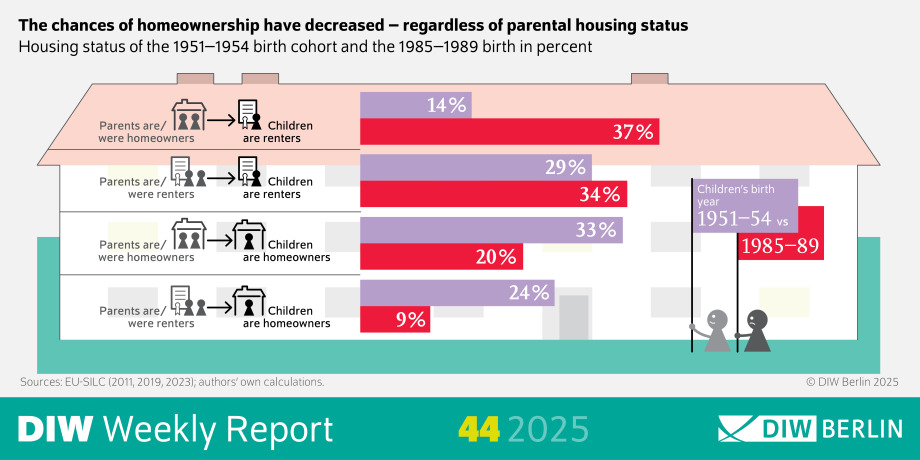
© DIW Berlin
Infographic for Lersch, P. M., Selçuk Bedük and Enrico Benassi (2025): Parental Influence on Their Children’s Homeownership Remains High, but Declining. DIW Weekly Report 44 / 2025, S. 299-307. (Audio-)Interview with Philipp M. Lersch (DIW) (only in German).
Poverty risk stagnates, but remains very high among refugees and the unemployed
High inflation in 2021/22 caused real wages and disposable incomes in Germany to fall for the first time since 2013. At the same time, however, inequality in gross hourly wages continued to decline, mainly due to positive developments at the lower end of the wage distribution. In terms of disposable income at the household level, however, inequality has been stagnating since 2020, as has the poverty risk rate. The risk of poverty has increased significantly, especially for the unemployed and refugees. These are the main findings of the latest survey on income distribution in Germany based on SOEP data, which are presented in detail in DIW-Wochenbericht 42/2025 (only in German). “The good news is that since 2020, the poverty risk rate among refugees has been falling again slightly, which is likely due to increasing labor market integration,” says study author Markus M. Grabka. It is clear that work protects against poverty. He therefore recommends: "In order to reduce income inequality and the risk of poverty, the integration of certain groups into the labor market should be promoted more strongly. The transfer system would also have to be reformed, as an increase in working hours has little noticeable effect on the wallets of those in the lower income bracket.
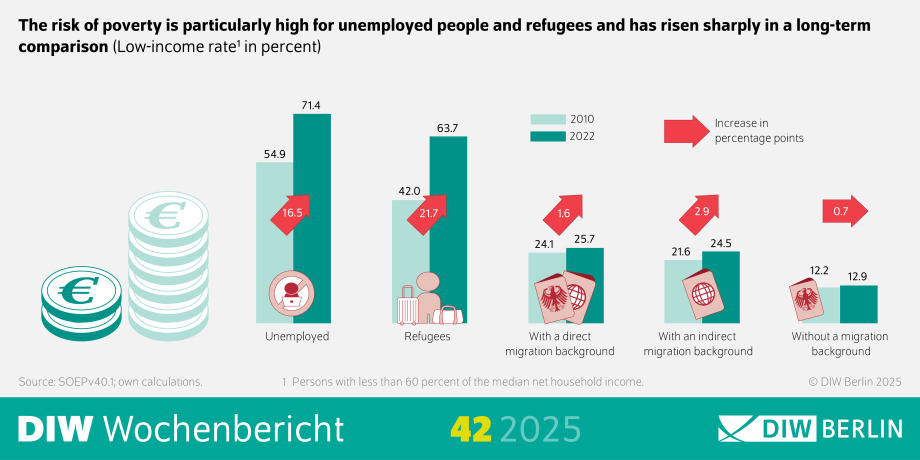
Infographic for Grabka, M. M. and Erich Wittenberg (2025): Armutsrisiko stagniert, ist aber bei Menschen mit Migrationshintergrund und Erwerbslosen weiterhin hoch. DIW- Wochenbericht 42/2025, 663-671. (Audio-)Interview with Markus M. Grabka (DIW) (only in German).
Narratives on the Distributional Impact of Climate Policy Can Fuel Populism
Populist parties deliberately use narratives of social injustice to portray climate policy as antisocial and driven by elites. A new SOEP study based on a survey experiment with around 1,600 people shows that all three narratives examined—namely, that climate policy measures would primarily burden poorer households, that companies would shirk their responsibilities, and that the German economy would be weakened—reinforce climate populist attitudes. Specifically, the income narrative negatively affects satisfaction with democracy. Women, low-income groups, East German voters, and right-wing voters react particularly strongly to the income narrative. The corporate narrative, on the other hand, has the greatest impact among men, in East German regions, and among left-wing voters. The economic narrative, according to which climate policy weakens the German economy, resonates particularly with right-wing voters.
If measures are perceived as fair – for example, through socially balanced compensation mechanisms such as climate money – polarizing narratives lose their effect. Transparent communication that does not avoid distribution conflicts but addresses them openly is also crucial.
SOEP doctoral student Lorenz Meister conducted the study together with Matilda Gettins from FiscalFuture, a non-governmental organization, and presented it in DIW Weekly Report 38+39/2025.
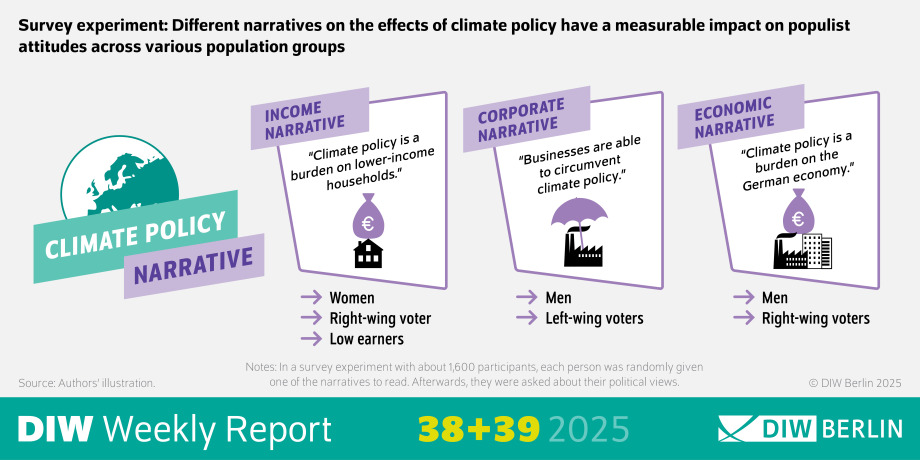
© DIW Berlin
Infographic for Gettins, M. und Lorenz Meister (2025): Narratives on the Distributional Impact of Climate Policy Can Fuel Populism. DIW Weekly Report 38+39/2025, S. 245-252. (Audio-)Interview with Lorenz Meister (DIW) (only in German).
Refugees feel less welcome in Germany – 98 percent want full citizenship
"Integration progresses at different speeds in different areas – only with a longer period of residence can certain developments such as naturalization behavior or the growth of the second generation be examined. Thanks to reliable data, this is now possible," says Cornelia Kristen, DIW Fellow at SOEP, referring to DIW-Wochenbericht 35/2025 (full issue only in German, for English articles check the infographics), which examines various aspects of integration from the perspective of people seeking protection in the form of three analyses. The calculations are based on the IAB-BAMF-SOEP survey of refugees who came to Germany between 2013 and 2019.
Many refugees in Germany feel less welcome today than when they arrived. At the same time, concerns about xenophobia are growing. Refugees sometimes feel discriminated against in the labor and housing markets. There are differences depending on gender, educational level, and region: Refugee men perceive discrimination when looking for housing in eastern Germany much more strongly than in western Germany. Transparent award procedures and anonymous applications could create equal opportunities, says Study author Ellen Heidinger.
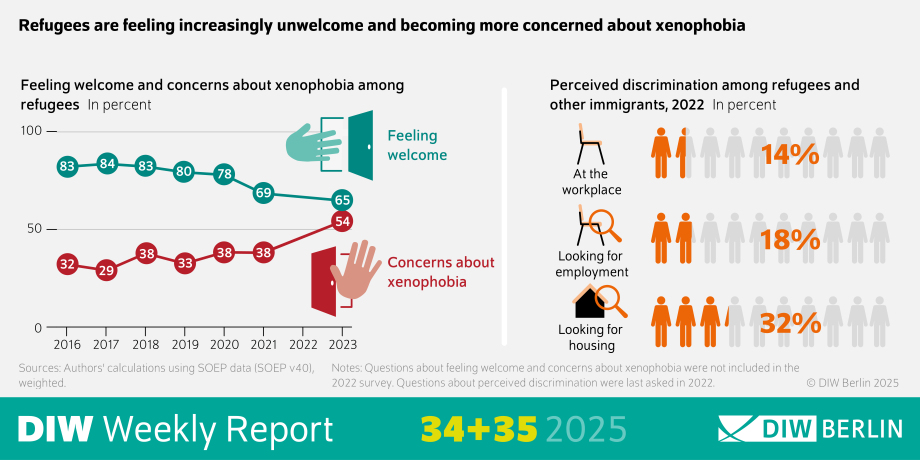
© DIW Berlin
Infographic for Cumming, P. and Ellen Heidinger (2025): Refugees Are Feeling Increasingly Unwelcome and Perceiving Discrimination in the Labor and Housing Markets. DIW Weekly Report 34+35/2025, S. 201-209. (Audio-)Interview with Ellen Heidinger (DIW) (only in German).
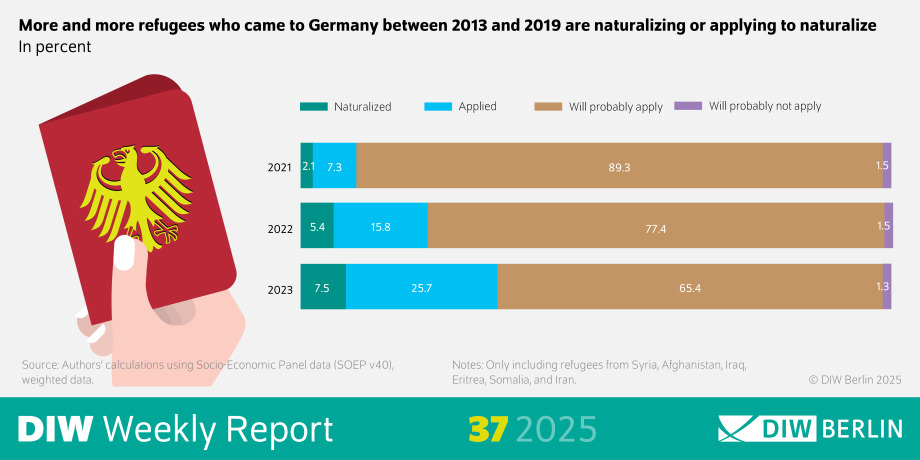
Nevertheless, willingness to apply for naturalization is high, with less than two percent of respondents not planning to apply. The 2024 reforms to citizenship law shortens the residence period required for naturalization, but at the same time increase the requirements for economic independence. Particularly vulnerable groups—such as single parents or low-skilled workers—will be held back. “Naturalization is a key step toward social participation. But the reform threatens to exclude precisely those who would benefit most from it. This squanders valuable opportunities for integration,” notes study author Jörg Hartmann.
© DIW Berlin
Infographic for Hartmann, J. (2025): Refugees Want to Stay in Germany Long Term and Become German Citizens. DIW Weekly Report 37/2025, S. 235-241.
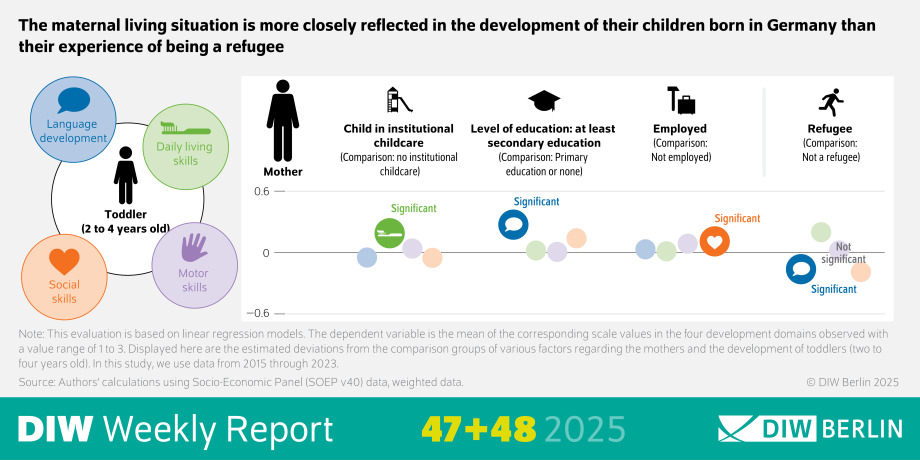
Another key finding is that the development opportunities of children born in Germany to refugees depend on social and structural living conditions and not on the refugee experience. Children born in Germany to refugee mothers show no differences from other children in Germany in terms of birth weight, length, caesarean section frequency, and breastfeeding behavior. In early childhood, however, developmental differences in language, motor skills, and social behavior become apparent. These can be explained largely by the mother's mental health, education, and employment status, as well as access to institutional care.
© DIW Berlin
Infographic for Heidemann, V. and Sabine Zinn (2025): Mothers’ Living Conditions Shape Health and Early Development, While Refugee Experience Has Little Impact. DIW Weekly Report 47+48/2025, 321-330.
Sabine Zinn draws a mixed conclusion overall: "After ten years, most male refugees have entered the labor market. However, refugee women in particular are significantly less likely to be in employment. Most refugees seek naturalization – a sign that they want to stay in Germany permanently. However, structural barriers continue to exist that make participation difficult. These lie primarily in a lack of targeted education and labor market integration."
The example of England shows that every day missed at school is associated with poorer final grades
The number of days missed at school in Berlin has risen significantly since the coronavirus pandemic – to around nine percent per school year – and is thus at a similarly high level as in England. In contrast to Germany, detailed data on absenteeism and school performance has been collected in England for years. According to a SOEP study presented in DIW-Wochenbericht 34/2025 (only in German), involving two researchers from the University of Glasgow and the University of Strathclyde in Glasgow, every day of school missed – whether excused or not – is associated with poorer final grades at the end of the eleven-year compulsory schooling period. Absences in the first and sixth to tenth grades have particularly severe consequences. In Germany, the final phase of elementary school could be particularly critical, as this is when the course is set for the transition to secondary school. “Absences are not only harmful in the short term, but in many cases have a lasting impact on the entire course of education and later working life,” says study author Jascha Dräger. For this reason, absences should be systematically recorded and published in all federal states. In addition, schools should be better prepared to systematically make up for missed content, for example, through school-organized support programs or individual learning plans. Existing concepts for reducing absenteeism should be implemented consistently. To this end, schools would need to be equipped accordingly, both financially and in terms of personnel.
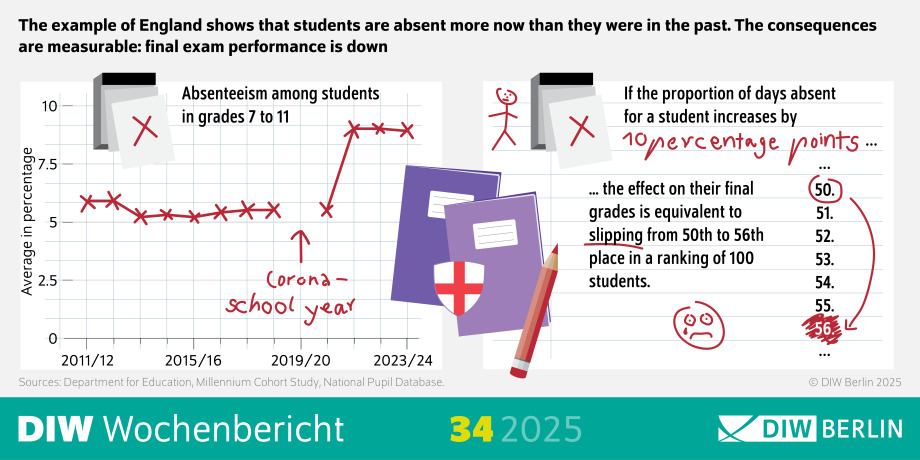
Infographic for Dräger, J., Markus Klein and Edward Sosu (2025): Beispiel England zeigt: Jeder Fehltag in der Schule geht mit schlechteren Abschlussnoten einher. DIW- Wochenbericht 34/2025, 511-518. (Audio-)Interview with Jascha Dräger (DIW) (only in German).
Staff News keyboard_arrow_up
Successful Promotions
Barbara Stacherl successfully defended her dissertation
On September 9, Barbara Stacherl successfully defended her dissertation entitled “Spatial Healthcare Access: Measurement, Health-Related Outcomes, and Healthcare Utilization” with summa cum laude at Bielefeld University.
Barbara submitted and defended her dissertation as part of the Public Health doctoral program.
The committee consisted of Prof. Odile Sauzet (primary supervisor, Bielefeld University), Assoc. Prof. Anna-Theresa Renner (secondary supervisor, Vienna University of Technology), Prof. Oliver Razum (Bielefeld University), and Prof. Anna Oksuzyan (Bielefeld University).
We congratulate Barbara on this outstanding achievement!

The commission (from left to right): Prof. Oliver Razum (Bielefeld University), Prof. Anna Oksuzyan (Bielefeld University), Assoc. Prof. Anna-Theresa Renner (second supervisor, Vienna University of Technology) and (right) Prof. Odile Sauzet (first supervisor, Bielefeld University) at the thesis defense of Barbara Stacherl (second from right)
© SOEP / DIW Berlin
The commission (from left to right): Prof. Oliver Razum (Bielefeld University), Prof. Anna Oksuzyan (Bielefeld University), Assoc. Prof. Anna-Theresa Renner (second supervisor, Vienna University of Technology) and (right) Prof. Odile Sauzet (first supervisor, Bielefeld University) at the thesis defense of Barbara Stacherl (second from right) © SOEP / DIW Berlin
Further Awards
Sabine Zinn was selected as one of the 100 most important minds in science in the capital in 2025
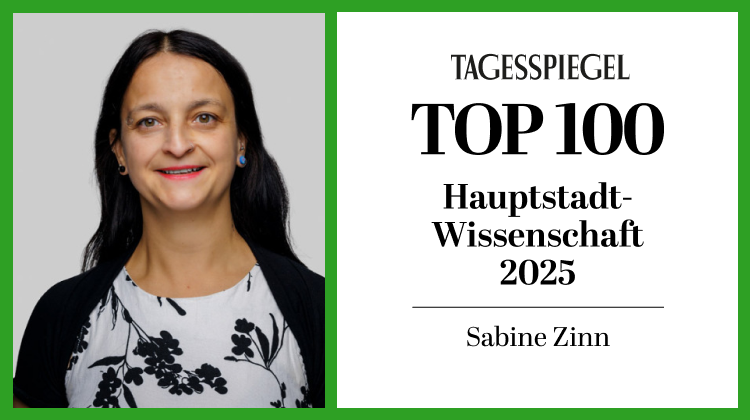
Every year, the Tagesspiegel editorial team selects 100 personalities who have had a particular impact on the Berlin-Brandenburg science region and are shaping the science of the future. The criteria are outstanding research, awards, special commitment to teaching or beyond, spin-offs, or science communication. Sabine Zinn is the second SOEP scientist in a row to be selected after Philipp Lersch in 2024 and was featured in the Tagesspiegel series “Die 100 wichtigsten Köpfe der Wissenschaft, Folge 9: Sie erforschen, was den Markt regelt (only in German)” (The 100 most important minds in science, episode 9: They research what regulates the market) (for subscribers only)”.
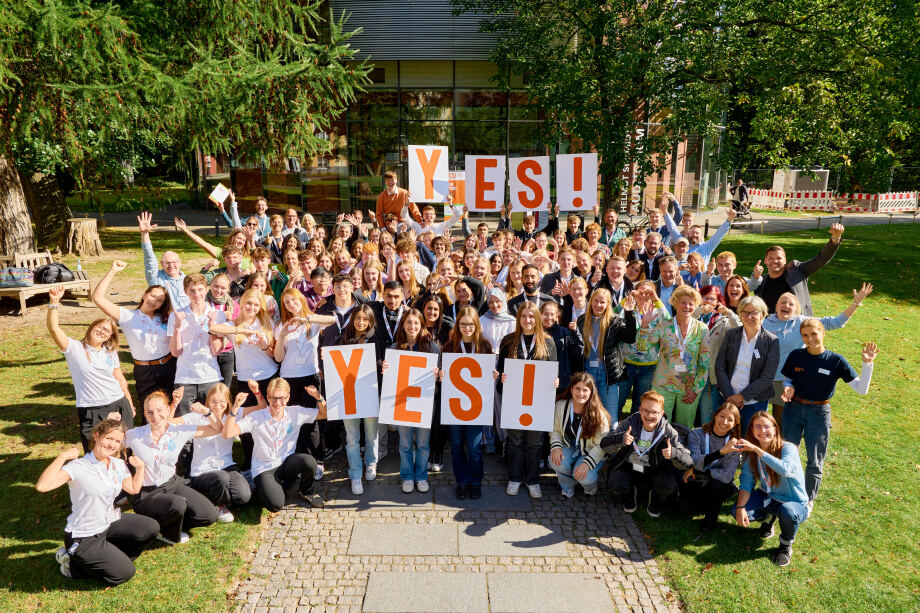
YES! Young Economic Solutions
At YES! Young Economic Solutions 2025, Florian Griese mentored a 10th grade class at Wiprecht Gymnasium in Groitzsch on their way to the national finals. The goal of the class project is to reduce gender stereotypes in education in order to ease the burden on mothers. The students want to make it easier for fathers to take on the tasks of parental leave by developing the “Held zu Hause” (Hero at Home) app with tips for young fathers.
YES! is Germany's largest school competition on global challenges in business, society, politics, and the environment for grades 10+. The aim is to promote entrepreneurial thinking and education for sustainable development (ESD) and to encourage young people to take an active role in shaping the future of society. School teams from different regions select real, socially relevant issues and spend several months developing concrete proposals for solutions. They are supported in this by mentors from science, business, and/or social enterprises. The young people learn not only to develop their ideas creatively, but also to reflect on their implementation potential in terms of entrepreneurial solution strategies.
Further information can be found here. From 2026, the competition, previously run by the ZBW, will be organized by the German Climate Foundation. Funding will continue to be provided by the Joachim Herz Foundation.
© Yes!
Welcome to SOEP
Bettina Hünteler has been working as a postdoctoral researcher in the DECIPHE project since the beginning of August. She is also working on other issues of social inequality, such as health in relation to family and migration.
There are three new additions to the Division Applied Panel Analysis:
Marianna Magagnoli joined the team on September 22, Alexander Grawe has been working there as a doctoral student since October 1, and Lukas Menkhoff formerly research associate at DIW has joined the SOEP.
Paylag Torossian has been working as a research associate in the Division Data Operation and Research Data Center since November 7.
Appendix: Ankündigungen von externen Veranstaltungen und Call for Proposals keyboard_arrow_up
CfP: ISQOLS 2026 Winter Virtual Conference Pathways to Inclusive Well-being
29-30 January 2026 ABSTRACT SUBMISSION DEADLINE: 15 NOVEMBER The International Society for Quality-of-Life Studies (ISQOLS) is delighted to announce the ISQOLS 2026 Winter Virtual Conference, a two-day event dedicated to showcasing the work of emerging scholars in the field of quality-of-life studies.
This fully online conference will bring together early-career researchers from around the globe to share innovative insights on the many pathways to inclusive and equitable well-being. We welcome contributions that investigate the social structures, opportunities, and connections—both offline and online—that promote thriving communities. In particular, we encourage research on the ways digital interaction and social media influence well-being, from expanding access to opportunities and social support to shaping perceptions, aspirations, and life satisfaction.
Invitation to the Interdisciplinary Colloquium on Digitalisation of Research "Social Scientific Data Quality and Reproducibility in the AI Era: Challenges and Pathways" with Stefan Dietze
We are delighted to invite you to the next session of our Interdisciplinary Colloquium on Digitalisation of Research. Our December special guest will be Stefan Dietze (GESIS Leibniz Institute for the Social Sciences + Heinrich Heine University Düsseldorf) and he will give a talk on “Social Scientific Data Quality and Reproducibility in the AI Era: Challenges and Pathways”. Make sure to join us on Zoom or at FIZ Karlsruhe in person! The speaker will join online. Date: 4 December 2025, 11:00-12:00. Event website: here, Registration: here.
The Colloquium is organised by the Leibniz Science Campus "Digital Transformation of Research" (DiTraRe). We are investigating the effects and potential of the increasing digitalisation of scientific work in a multilevel approach. Our interdisciplinary consortium aims at establishing a new research branch.
This event is held monthly in a hybrid format, with each session hosted at a different institute to foster a diverse and enriching exchange of ideas. The Colloquium takes one hour, including a presentation and a discussion part. It aims to bring together researchers from various disciplines to discuss and explore the impact of digitalisation on research methodologies, data management, and collaborative practices.
"Data4Society" – Open Call für die 10. Konferenz für Sozial- und Wirtschaftsdaten (10|KSWD) / 10th Conference on Social and Economic Data
Die 10. Konferenz für Sozial- und Wirtschaftsdaten (10|KSWD) findet am 22. und 23. Juni 2026 in Berlin unter dem Motto „Data4Society“ statt.
Der ausführliche Call ist auf der KSWD-Homepage zu finden. Beiträge können bis zum 15.01.2026 über ConfTool eingereicht werden.
Call for Abstracts | 16th Scientific Conference | ADM, ASI, Destatis
We would like to draw your attention to our Call for Abstracts for the 16th Scientific Conference on Survey Methods of ADM, ASI, and the Federal Statistical Office, and invite you to submit an abstract and/or save the dates of 25–26 June 2026 in your calendar. The conference focuses on the theme of online surveys. You can find the call attached and further information on the event page.
The submission deadline is 31 January 2026. We will inform you on our website and by email as soon as registration is possible.
The conference will take place exclusively in person.
For further information and any questions, please contact us by email at Institut-Veranstaltungen@destatis.de.
Call for Papers – Bristol Applied Economics Meetings (BÆM 2026), 5–8 May, University of Bristol
We are pleased to announce the 3rd edition of the Bristol Applied Economics Meetings (BÆM), to be held 5–8 May 2026 at the University of Bristol. This year’s edition features three focused workshops:
Development Economics (5–6 May) – Confirmed speakers: Mushfiq Mobarak (Yale), Kate Orkin (Oxford), Imran Rasul (UCL), and Pauline Rossi (CREST).
Economics of Migration (6–7 May) – Confirmed speakers: Ran Abramitzky (Stanford), Joan Monras (UPF), and Caroline Theoharides (Amherst).
Fairness in the Economy (8 May) – Confirmed speakers: Ernst Fehr (Zurich), Roland Bénabou (Princeton), and Ingvild Almås (Zurich).
We invite submissions from all relevant subfields of applied economics and particularly encourage contributions from researchers of diverse backgrounds, career stages, and institutions worldwide.
The submission deadline is 31 January 2026. Further details and submission guidelines can be found on our website: https://www.baem.info/
We look forward to receiving your submission and to welcoming you to Bristol in May 2026.